


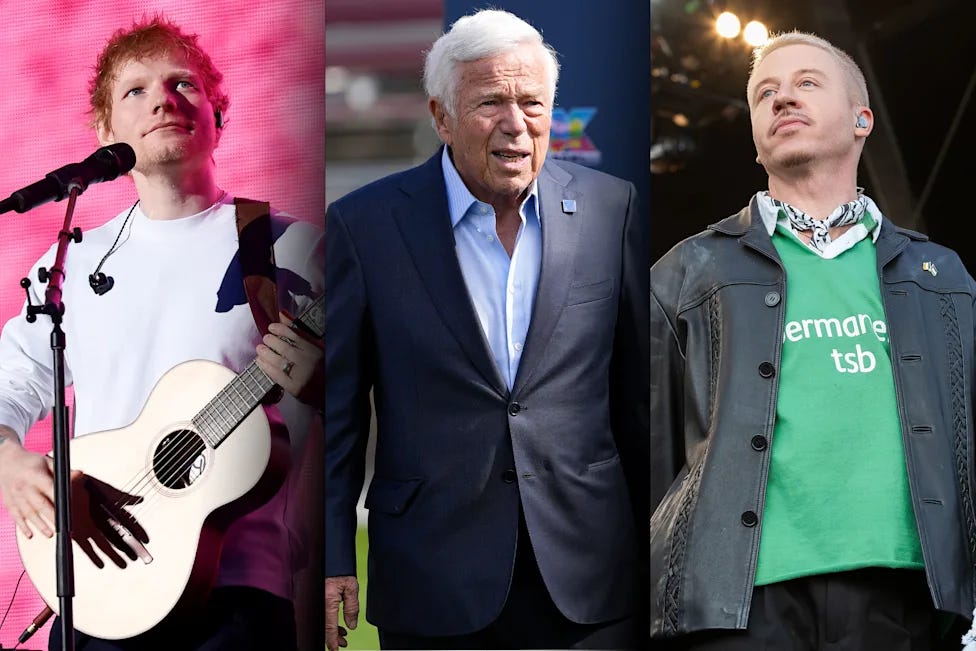
It would be easy to reduce the controversy surrounding Ed Sheeran and Macklemore to a simple story. One version says Macklemore was punished for speaking out for Palestinians, making his removal an example of wealthy venue owners and powerful entertainment interests using their leverage to silence political speech. Another says Macklemore used someone else’s stadium tour to deliver a highly charged and one-sided political message, against the backdrop of an earlier controversy involving imagery widely criticized as antisemitic, leaving venues and promoters to decide what they were willing to host. Both versions contain elements of truth. Both also leave important things out.
The real story is more complicated, and more revealing. The controversy exposes a distinction that arguments about free speech often miss: being free to say something is not the same as controlling access to the places where it can be heard. Macklemore controlled his words, but the stages on which he could deliver them depended on a network of artists, promoters, venue owners and operators, each with different forms of leverage. Understanding what happened therefore requires following that power rather than simply deciding who was right about Israel and Palestine.
Macklemore, the American rapper best known for songs like “Thrift Shop” and “Same Love,” was scheduled to open eight of the remaining 10 U.S. dates on Ed Sheeran’s stadium tour. Sheeran is one of the biggest pop stars in the world and regularly performs in front of tens of thousands of people. At MetLife Stadium in New Jersey, Macklemore used that audience to make an explicitly political statement.
He told the crowd that one reason he wanted to join the tour was to stand in large American stadiums and say “Free Palestine.” He spoke about Gaza and the occupied West Bank, praised pro-Palestinian student activists, accused Israel of apartheid and genocide, and performed “Hind’s Hall,” a song inspired by the campus protest movement that spread across American universities in 2024. This was not an offhand remark between songs. Macklemore was deliberately using access to a massive commercial audience to make a political argument.
What he actually said is important because some of the controversy has turned on whether advocacy for Palestinians crossed into hostility toward Jewish people. The published remarks from MetLife do not show Macklemore attacking Jewish people as a group. He directly told Jewish listeners that criticism of Israel was not criticism of them and described his message in terms of peace, dignity, respect, and equality. Nor is it accurate to say that Macklemore has never condemned Hamas’s October 7 attacks. In October 2023, he described the bombings, kidnappings, and killings of Israelis by Hamas as horrific and called the violence an “abomination,” while arguing that those attacks did not justify collective punishment of Palestinians. His most prominent advocacy since then has focused heavily on Palestinian suffering and Israeli conduct, but that is different from having excused or denied the violence against Israelis.
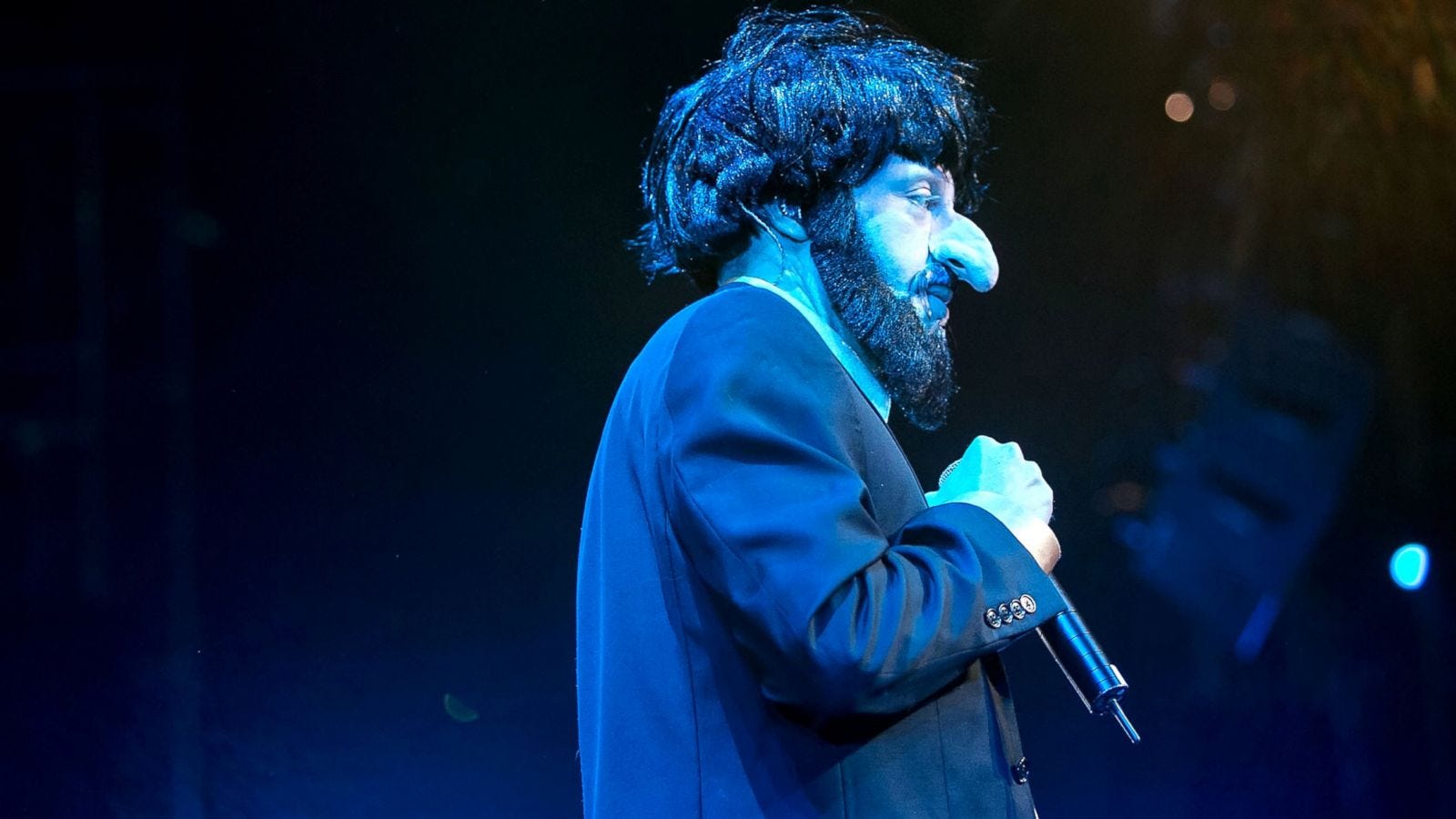
Macklemore’s critics, however, are not judging the MetLife performance in isolation. In 2014, he appeared onstage in a disguise that included a dark wig, beard, and exaggerated prosthetic nose. The costume was widely criticized for resembling an antisemitic caricature. More than a decade later, that incident has become part of the argument over how his current political activism should be understood.
Robert Kraft, the owner of the New England Patriots, whose Kraft Group owns Gillette Stadium in Massachusetts, made that broader record central to his objection. Kraft said Macklemore would not be permitted to perform at Gillette, citing his recent conduct, material displayed during the MetLife performances, and what Kraft described as a history of antisemitic rhetoric and imagery. He also accused Macklemore of presenting the conflict selectively and giving insufficient attention to Hamas’s responsibility for suffering among Israelis and Palestinians. Kraft stressed that his objection was not to advocacy for Palestinians itself. He acknowledged Palestinian suffering and argued that supporting Palestinians, opposing Hamas, and opposing antisemitism should not be treated as incompatible positions.
That is a more substantial argument than saying Macklemore was barred simply because he uttered the words “Free Palestine.” But it also does not settle the dispute. The MetLife remarks themselves contain an explicit attempt to distinguish criticism of Israel from hostility toward Jews, and Macklemore’s earlier condemnation of Hamas complicates the suggestion that he has simply ignored its violence. Kraft’s objection is therefore partly about the broader context he believes should be attached to Macklemore’s speech: the 2014 controversy, the imagery used during the performance, the accusations directed at Israel, and the relative emphasis Macklemore places on different parts of the conflict. The disagreement is not only over what Macklemore said. It is over what his words and record should mean when a venue decides whether to give him a stage.
But the objection to Macklemore was not confined to Gillette Stadium. Messina Touring Group, the promoter responsible for the U.S. leg of Sheeran’s tour, said multiple upcoming venues would not allow concerts to proceed with Macklemore on the lineup. Messina then removed him from the remaining dates. The company is not a small independent promoter. Messina Touring Group operates as part of the broader AEG Presents network, one of the major businesses in global live entertainment, illustrating how stadium tours depend on overlapping relationships among artists, promoters, venue operators, and owners.
This is where Sheeran’s role becomes more difficult to describe. He says Macklemore’s removal was the promoter’s decision, not his. He also says he spent days speaking with venues and others in an effort to find a solution, but that the venues and promoter ultimately would not change their position. Macklemore has likewise described difficult conversations with Sheeran rather than claiming that Sheeran personally initiated the effort to remove him.
It would nevertheless be misleading to portray the headliner of a stadium tour as powerless. Music-industry professionals interviewed by the Associated Press said major artists of Sheeran’s stature typically exercise substantial control over their tours, including creative decisions and support acts, while promoters generally handle much of the financing and logistics. Venues hold a different form of leverage because they can refuse to host a show. The result is a system in which influence and formal authority do not necessarily sit with the same actor.
We do not have the contracts or private communications necessary to know whether Sheeran could have forced unwilling venues to accept Macklemore, relocated shows, threatened cancellation, or pursued some other workable alternative. What the public record does establish is that venues threatened not to host shows with Macklemore on the bill, Messina removed him, and Sheeran participated in efforts to resolve the dispute before continuing the tour without him. It is therefore too simple to describe Macklemore’s removal as a decision made by Sheeran alone. It is equally difficult to characterize Sheeran as having no meaningful role. The evidence shows influence; it does not establish ultimate control.
Sheeran has also resisted being placed neatly on either side of the underlying political conflict. He has said he is appalled by the suffering caused by the Israel-Palestine conflict and has personal views that he chooses not to make part of his public platform. He says his concerts are intended to offer unity, joy, and escapism rather than function as political forums, while also saying he respects Macklemore’s determination to speak publicly about what he believes. Critics see that posture as an inadequate form of neutrality. But criticism of Sheeran’s approach is not evidence that he supports the Israeli government or opposes Palestinian rights.
There is another fact that complicates simple assumptions about both Sheeran and Kraft. Kraft says Sheeran committed $2 million to Palestinian humanitarian aid and personally asked Kraft to match that amount. Kraft agreed, according to his account. The conversation occurred before Macklemore publicly announced that he would donate roughly $1 million in net tour earnings to six organizations assisting Palestinians and challenged Kraft to match his contribution. The humanitarian commitments do not resolve the dispute over Macklemore, and they do not tell us what either Sheeran or Kraft believes about every aspect of the conflict. But they are relevant when evaluating claims that their positions can be explained simply by indifference toward Palestinian suffering.
Other musicians made a different calculation. Finneas, Lukas Graham, Aaron Rowe, and Beoga withdrew from upcoming tour appearances or their involvement with the tour after Macklemore’s removal. In explaining their decisions, they cited solidarity with Macklemore, opposition to silencing political expression, and concerns about the influence of money and institutional power. Their departures turned what had begun as a conflict between one performer, a promoter, and several venues into a broader argument within the music industry over who gets to set the boundaries of political expression.
The phrase “free speech” has consequently appeared throughout the controversy, but it can obscure as much as it clarifies. The First Amendment generally restricts government action, not the choices of private businesses. A privately controlled stadium ordinarily does not have a constitutional obligation to provide an artist with a stage. A promoter can decline to book a performer, just as a newspaper can decline an op-ed or a bookstore can choose what it sells. Such decisions may be described as censorship in the broader cultural sense without necessarily amounting to unconstitutional censorship. The analysis could be different if a government entity itself participated in excluding a performer because of his political viewpoint, but the public record has not established that here.
The legal question is also different from the question of responsibility. Macklemore chose to make political advocacy part of his performance. Kraft chose to bar him from Gillette. Other venues or their operators objected to his continued participation. Messina responded by removing him. Sheeran participated in efforts to resolve the dispute and then continued the tour without him. Other musicians responded by leaving. The controversy is better understood as a chain of decisions than as a single act by a single person.
Important parts of that chain remain hidden. Messina has not publicly identified every venue that objected or provided a venue-by-venue account of what each demanded. Macklemore has alleged that Kraft helped rally other stadium owners against him, but Kraft’s role in coordinating other venues has not been independently established in the public record. We also do not know what contractual alternatives Sheeran possessed, what those alternatives would have cost, or whether any could realistically have preserved both Macklemore’s place on the tour and the scheduled stadium dates. Those unknowns limit how confidently responsibility can be assigned.
They do not, however, prevent the controversy from revealing something larger. Speech in America is shaped not only by government rules but by access to institutions. Employers, universities, publishers, technology companies, sponsors, promoters, donors, and venue operators can determine who receives an audience, who receives amplification, and under what conditions. In the stadium concert business, those decisions are distributed across artists with enormous commercial value, global promotion companies, private venue operators, wealthy owners, and sometimes public authorities. No single participant necessarily controls the entire system, but each may possess enough leverage to change what ultimately reaches the stage.
None of that means an artist has an automatic right to someone else’s platform. Kraft and other private venue operators have their own rights of association and substantial authority over what they are willing to host. Macklemore also knew that turning a stadium performance into political advocacy could carry professional consequences. Sheeran was entitled to decide that cancelling an enormous tour would impose costs on fans, workers, and other musicians that he was unwilling to accept. The departing artists were equally entitled to conclude that remaining on the tour conflicted with their own principles. The difficult question is not whether these people were free to make choices. They were. It is how much power each choice carried.
The more revealing story, then, is about what happens when the freedom to speak meets the power to provide access. Someone owns or operates the building. Someone promotes the show. Someone signs the contracts. Someone can refuse to host it. Someone can decide that the financial or reputational cost has become too high. The person holding the microphone may control what he says into it, but not whether another microphone will be waiting at the next stadium.
Macklemore controlled what he said from the stage. He did not control whether there would be another one.
Evidence & Source Transparency
Evidence First shows its work. The article ends above; this section is included so readers can inspect the main sources behind the factual claims.
The list below does not source every sentence. It focuses on the factual claims most important to the argument.
1. What Macklemore said at MetLife Stadium
Claim or topic:
Macklemore used his MetLife Stadium appearance to call for a “Free Palestine,” praise pro-Palestinian student activists, criticize Israel’s conduct, and explicitly tell Jewish listeners that his criticism of Israel was not criticism of them.
Source:
Boston Globe: transcript of Macklemore’s MetLife remarks
Source type:
Reputable journalism based on a recorded public performance.
What it supports:
The Globe published a transcript of the relevant remarks, allowing readers to evaluate Macklemore’s actual words rather than relying on descriptions of them.
Important caveat:
The transcript establishes what Macklemore said during this portion of the performance. It does not by itself resolve broader arguments about the imagery used during the show or Macklemore’s record outside this performance.
2. Macklemore’s earlier condemnation of Hamas
Claim or topic:
Macklemore had publicly condemned Hamas’s October 7 attacks before the 2026 controversy, so claims that he never condemned the attacks omit relevant evidence.
Source:
Pitchfork: Macklemore’s 2023 statements on Hamas, Israel and Gaza
Source type:
Reputable journalism reporting Macklemore’s public statements.
What it supports:
Pitchfork reported that Macklemore’s October 2023 statement condemned the Hamas attacks while also sharply criticizing Israel’s subsequent actions in Gaza.
Important caveat:
Condemning Hamas in 2023 does not determine whether later speeches were balanced, persuasive or appropriate. It establishes the narrower factual point that he had publicly condemned the attacks.
3. The 2014 costume controversy
Claim or topic:
In 2014, Macklemore performed wearing a dark wig, fake beard and large prosthetic nose, prompting widespread criticism that the costume resembled an antisemitic Jewish caricature.
Source:
The Guardian: Macklemore costume controversy
Source type:
Reputable journalism.
What it supports:
Contemporary reporting documents the costume, the criticism it generated and the dispute over how it should be interpreted.
Important caveat:
The appearance of the costume and the criticism are documented. The incident itself does not establish Macklemore’s internal intent, and the article does not claim that it does.
4. Robert Kraft’s stated reasons for barring Macklemore
Claim or topic:
Robert Kraft said Macklemore would not be permitted to perform at Gillette Stadium because of his recent conduct, material presented during the MetLife shows and what Kraft described as a broader history of antisemitic rhetoric and imagery. Kraft also said his objection was not to advocacy for Palestinians itself.
Source:
GBH: Robert Kraft’s statement on Macklemore
Source type:
Reputable journalism reproducing a primary statement.
What it supports:
GBH published Kraft’s detailed explanation, including his criticism of Macklemore and his statement that Palestinian advocacy, opposition to Hamas and opposition to antisemitism should not be treated as incompatible.
Important caveat:
This source establishes Kraft’s stated rationale. It does not independently prove that Kraft’s characterization of Macklemore’s broader record is correct, nor does it establish Macklemore’s allegation that Kraft coordinated opposition among other stadium owners.
5. Venue pressure and Macklemore’s removal from the tour
Claim or topic:
Macklemore was scheduled for eight of Sheeran’s remaining 10 U.S. stadium shows. Messina Touring Group said venues would not allow shows to proceed with Macklemore on the lineup, and he was subsequently removed.
Source:
Reuters: Macklemore dropped from Ed Sheeran’s U.S. tour
Source type:
Reputable journalism and company information.
What it supports:
Reuters documents the removal, venue opposition and the eight-of-10 remaining-show figure. AEG Presents identifies Messina Touring as part of its network, providing context for the promoter’s place in the live-entertainment industry.
Important caveat:
Messina has said multiple venues objected, but a definitive public venue-by-venue account of who objected, what each demanded and how the decisions were coordinated has not been released.
6. Ed Sheeran’s role and the distribution of power on a stadium tour
Claim or topic:
Sheeran says removing Macklemore was the promoter’s decision rather than his, while also acknowledging that he spent days speaking with venues in an effort to resolve the dispute. Industry professionals say major artists typically have substantial influence over their tours, while promoters and venues hold different forms of contractual and practical power.
Source:
Associated Press: how artists, promoters and venues divide power on major tours
GBH: Sheeran’s response and supporting acts’ withdrawals
Source type:
Reputable journalism, including industry-expert analysis and Sheeran’s public statement.
What it supports:
The reporting supports the article’s distinction between influence and ultimate control. It also documents Sheeran’s account that he tried to find a resolution, the promoter’s role in removing Macklemore and the subsequent withdrawal of Finneas, Lukas Graham, Aaron Rowe and Beoga.
Important caveat:
The tour contracts and relevant private communications are not public. The available evidence therefore does not establish exactly what contractual powers or realistic alternatives Sheeran possessed.
7. Palestinian humanitarian-aid commitments
Claim or topic:
Kraft says Sheeran committed $2 million to Palestinian humanitarian aid and asked Kraft to match it. Macklemore separately announced roughly $1 million in tour earnings for organizations assisting Palestinians.
Source:
Variety: Kraft’s account of Sheeran’s $2 million commitment
People: Macklemore’s $1 million pledge
Source type:
Reputable entertainment journalism reporting public statements.
What it supports:
The reporting documents Macklemore’s announced donation and Kraft’s statement that Sheeran had asked him to match a $2 million humanitarian commitment.
Important caveat:
Sheeran’s $2 million commitment is presented in the article as Kraft’s account rather than as independently documented proof of a completed donation. Variety reported that details about the recipients were not yet clear.
8. The First Amendment distinction
Claim or topic:
Private decisions about who may perform at a venue are not automatically First Amendment violations. Government involvement in viewpoint-based exclusion could present a different constitutional question.
Source:
GBH: First Amendment questions surrounding Macklemore’s removal
Source type:
Reputable journalism citing a free-speech legal expert.
What it supports:
The source explains the distinction between restrictions imposed by private actors and restrictions attributable to government entities, which is the limited constitutional distinction made in the article.
Important caveat:
The public record has not established that a government entity participated in excluding Macklemore because of his political viewpoint. The article therefore does not claim that his removal violated the First Amendment.
How to read this evidence
This article is the author’s analysis. The sources above are provided so readers can see where the factual claims come from and judge the evidence for themselves. Some sources support direct facts, while others provide context, estimates, or background evidence.
Corrections and updates
If a factual error is identified, this post will be corrected in the web version with a dated note explaining the change. Because email versions cannot be edited after sending, the web version should be treated as the current version.