


Three years ago today, Hamas-led fighters crossed from Gaza into southern Israel, killing about 1,200 people and taking 251 hostages. Hamas, an Islamist political and armed movement, had governed Gaza since 2007.
Israel responded with a large-scale war. Its government said it intended to return the hostages, dismantle Hamas’s military and governing capabilities, and prevent Gaza from again being used to launch an attack like the one on Oct. 7, 2023.
Three years later, much of the immediate record is clear. Hamas is militarily weaker than it was before the war. Much of its senior leadership was killed, its forces suffered heavy losses, and U.S. intelligence now describes the organization as degraded. All 251 hostages were eventually either returned alive or had their remains returned.
Yet Hamas survived. It remains armed, and the same U.S. intelligence assessment says it has used the cease-fire to restore some capabilities and reassert control in parts of Gaza. The United Nations reported in September that Hamas and other armed groups had not disarmed, while the Palestinian governing and international security arrangements envisioned for postwar Gaza were still not fully operating there.
That combination, a badly weakened Hamas that nonetheless remains intact, is the key to understanding both what Israel achieved and what it did not.
The wrong question may be whether Hamas still exists. The more useful one is what Hamas can still do.
Hamas is not simply a collection of fighters and weapons. It is also a political movement with an ideology, a bureaucracy, and roots in Palestinian society. Military force can kill leaders, destroy weapons, and disrupt command networks. Those actions can reduce an organization’s ability to fight without necessarily causing the organization itself to disappear.
Research conducted before the current war helps explain why. Political scientist Jenna Jordan examined years of Israeli efforts to kill or capture Hamas leaders and found that the group’s organizational structure, ideology, and social base made it unusually resilient to leadership losses. Her broader research found that large, established, religious, and separatist militant groups were especially likely to survive the deaths of senior leaders.
That research does not show that Hamas can never be dismantled. The war that began in 2023 was far larger than the leadership-targeting campaigns covered by those studies. But it does show why simple organizational survival is an incomplete measure of military success.
Capability is more revealing.
Can Hamas field a large, organized fighting force? Can it rebuild major tunnel networks and command centers? Can it acquire or manufacture large quantities of weapons? Can it control territory in ways that allow it to train, organize, and plan? Most importantly, can it again prepare and carry out a cross-border attack on anything approaching the scale of Oct. 7?
By those measures, Hamas is substantially less capable than it was three years ago. U.S. intelligence also says, however, that it has begun restoring some of what it lost.
That is a more precise description of Israel’s principal military achievement. It did not make Hamas disappear. It significantly reduced its ability to fight.
The hostage objective was more concrete. According to a 2026 United Nations report, 168 of the 251 people abducted on Oct. 7 were eventually returned alive. The last living hostage returned in October 2025, and the final remains were returned in January 2026.
With the hostages returned and Hamas badly weakened, the war’s most difficult question is no longer about what happened during the fighting. It is about what happens after it.
The cease-fire that took effect in October 2025 ended the period of large-scale hostilities, though not all violence. Israeli strikes and military operations have continued. Hamas and other armed groups remain armed. And the system intended to govern Gaza after the war has not yet fully taken hold.
On paper, the proposed postwar arrangement is straightforward. Hamas would give up its weapons and cease operating as an independent military force. A new Palestinian administration would govern Gaza. Palestinian police would handle day-to-day security, supported by outside monitoring and an international stabilization force. Israeli troops would withdraw in stages as those arrangements became operational.
In practice, the most important elements remain incomplete.
That is the central strategic problem because destroying military capabilities and preventing their return are two different tasks. Israel has already shown that it can kill commanders, destroy weapons, collapse tunnels, and disrupt military planning. What remains unproven is whether Hamas, or another armed organization, can be prevented from rebuilding once the heaviest military pressure recedes.
The fact that Hamas is both degraded and already restoring some capabilities illustrates the problem.
There is no historical formula for solving it. Gaza differs in important ways from the civil wars and insurgencies that make up much of the research on post-conflict security. But those cases offer some clues.
United Nations programs dealing with armed groups generally do not stop at collecting weapons. They also seek to break up fighting units and help former combatants move into civilian life. Other research on post-conflict settlements has found that functioning government, credible policing, and outside monitoring can make renewed violence less likely, particularly when former enemies do not trust one another to comply with an agreement.
The lesson is not that Gaza can simply copy another country’s model. It is that military gains tend to be more durable when an armed group loses not only weapons but also the ability to rebuild them under the protection of weak or absent institutions.
That is why the current Gaza plan includes more than Hamas disarmament. It also calls for Palestinian police, a replacement governing authority, outside monitoring, and an international stabilization force. None of those measures is guaranteed to work. But all are aimed at the same unresolved problem: preventing the capabilities Israel destroyed from being recreated.
As of September, that system remained largely unfinished. Hamas had not disarmed, the replacement Palestinian administration had not fully assumed power, and the international security force had not deployed.
That unfinished transition also changes how the question of renewed large-scale fighting should be judged.
Another major offensive could destroy additional Hamas fighters, weapons, and infrastructure. Israel’s previous operations provide strong evidence that it is capable of doing so. The harder question is whether the additional destruction would make Israel meaningfully safer for longer, or whether Hamas would eventually rebuild again.
Ending military pressure altogether presents the opposite risk. Hamas remains armed, and U.S. intelligence says it has already recovered some capabilities during the cease-fire.
That makes “continue the war” or “end the war” too crude a choice. The more useful test is whether any proposed strategy, renewed military action, negotiated disarmament, international security arrangements, or some combination, can keep Hamas from rebuilding the military capabilities necessary for another major attack.
And that test cannot be separated from cost.
Israel has already spent heavily. The Bank of Israel estimates the fiscal cost of the war at roughly 350 billion shekels from 2023 through 2026, or about $114 billion at early-October exchange rates. It estimates another 177 billion shekels, roughly $58 billion, in lost economic output through the end of 2025. Government debt rose from 60.5 percent of gross domestic product before the war to 68.5 percent by the end of 2025.
The military cost has also been substantial. As of late September, the Israel Defense Forces listed 970 military deaths since Oct. 7, including 472 since the start of the Gaza ground operation, along with thousands wounded. The larger total includes deaths on Oct. 7 itself and in other theaters, so it should not be read as the death toll from the Gaza campaign alone.
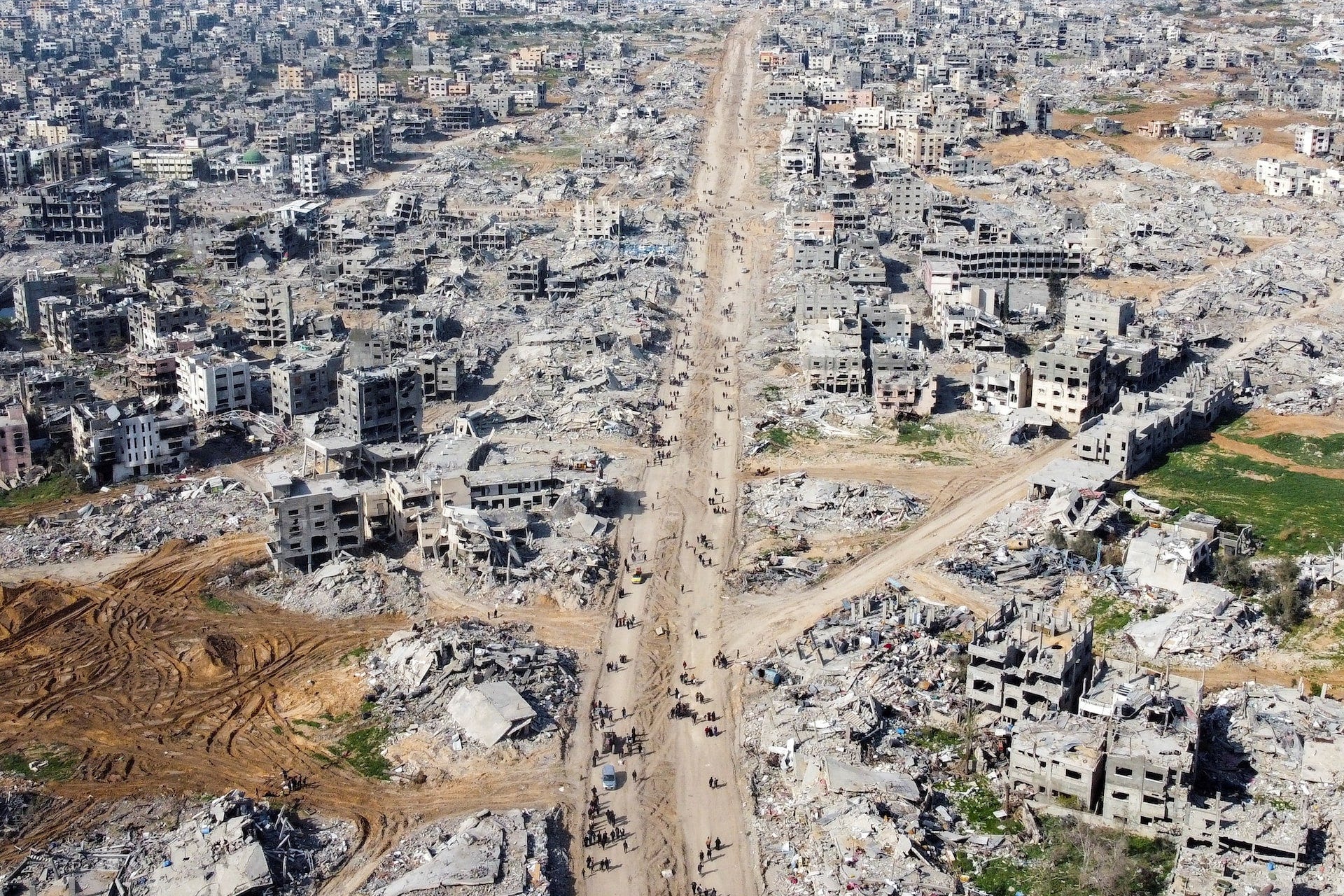
The human and physical costs in Gaza have been far greater. By late September, Gaza health authorities were reporting more than 74,000 Palestinian deaths. United Nations agencies use those figures while identifying Gaza’s Ministry of Health as the source. The total does not by itself establish precisely how many of the dead were civilians and how many were fighters.
A joint assessment by the World Bank, United Nations, and European Union estimated roughly $35 billion in physical damage and more than $71 billion in recovery and reconstruction needs.
Those numbers matter not only as a record of the past. They change the calculation from here.
Israel is no longer making decisions against the Hamas that existed on Oct. 6, 2023. It is making them against an organization already weakened by three years of war, after the hostages have been returned and after Gaza has suffered enormous destruction.
That means the relevant measure of any new military action is its marginal benefit: what additional threat it removes, how long that gain is likely to last, and what additional human, economic, and political costs are required to achieve it.
An operation that removes a serious remaining capability and makes its return difficult could have lasting security value. An operation that destroys capabilities Hamas later rebuilds would produce a real but temporary gain. A diplomatic arrangement that allows Hamas to rearm rapidly would fail the same test.
The method matters. But the durability of the result matters more.
Three years after Oct. 7, the basic record is no longer especially mysterious. Israel substantially reduced Hamas’s military capabilities. The hostages were returned. Hamas nevertheless remains armed, has begun restoring some of its strength, and has not yet been replaced by a fully functioning governing and security system in Gaza.
The most meaningful test of the war is therefore not whether Hamas still exists. It is whether Gaza can again produce an armed organization with the manpower, weapons, command structure, and freedom of action necessary to carry out an attack remotely comparable to Oct. 7.
For now, the evidence indicates that Hamas is substantially less capable of doing that than it was three years ago.
The unresolved question is whether it will stay that way.
That answer will emerge not from declarations of victory or defeat, but from observable facts: whether Hamas continues rebuilding or continues weakening, whether weapons and military infrastructure return, whether another Palestinian authority can govern and police Gaza, and whether Israel can eventually reduce its military presence without facing another large-scale threat from the territory.
If those conditions take hold, there will be evidence that Israel converted battlefield gains into durable security.
If Hamas repeatedly rebuilds and Israel repeatedly has to destroy the same capabilities, there will be evidence that the war changed the balance of power without solving the underlying security problem.
Three years after Oct. 7, Israel has already shown what military force can destroy.
What remains to be shown is whether what was destroyed can be kept from returning.
Evidence & Source Transparency
Evidence First shows its work. The article ends above; this section is included so readers can inspect the main sources behind the factual claims.
The list below does not source every sentence. It focuses on the factual claims most important to the argument.
1. Israel’s stated war aims
Claim or topic:
Israel said its objectives included returning the hostages, dismantling Hamas’s military and governing capabilities, and preventing Gaza from again posing a comparable threat.
Source:
Source type:
Primary document.
What it supports:
The source documents the Israeli government’s stated objectives during the war.
Important caveat:
This establishes what Israeli leaders publicly said their objectives were. It does not establish whether those objectives were achieved or whether other unstated objectives existed.
2. Hamas’s military condition three years later
Claim or topic:
Hamas is substantially weaker than before the war, but it remains active and has begun restoring some capabilities and control in parts of Gaza.
Source:
U.S. Office of the Director of National Intelligence, 2026 Annual Threat Assessment
Source type:
Government assessment.
What it supports:
The assessment describes Hamas as degraded while also reporting that it used the cease-fire period to restore some capabilities and control.
Important caveat:
The assessment does not provide a complete public accounting of Hamas’s current manpower, weapons, tunnels, or ability to carry out another attack on the scale of Oct. 7. Claims about its exact remaining capacity therefore remain uncertain.
3. The hostages
Claim or topic:
All 251 people taken hostage on Oct. 7 were ultimately either returned alive or had their remains returned; 168 were returned alive.
Source:
United Nations report on implementation of Security Council Resolution 2803
Source type:
Primary document.
What it supports:
The U.N. report provides the hostage totals and dates for the return of the last living hostage and the final remains.
Important caveat:
The article uses this source to establish the outcome, not to determine how much military pressure, negotiation, diplomacy, or other factors caused the releases.
4. Hamas disarmament and Gaza’s unfinished postwar system
Claim or topic:
Hamas and other armed groups had not disarmed as of September 2026, and the planned replacement governing and international security arrangements were not yet fully operating in Gaza.
Source:
United Nations, September 2026 Gaza report
U.N. Security Council Resolution 2803
Source type:
Primary documents.
What it supports:
The September report describes the status of Hamas disarmament, Palestinian governing arrangements, and the proposed international stabilization force. Resolution 2803 describes the planned postwar structure, including disarmament, Palestinian policing, international involvement, and phased Israeli withdrawal.
Important caveat:
The resolution describes an intended framework, not an accomplished outcome. The article distinguishes between the plan on paper and the degree to which it had actually been implemented.
5. Why Hamas’s continued existence is not the same as military failure
Claim or topic:
Research predating the war found that Hamas and similar established militant organizations can survive severe leadership losses, making simple organizational survival an incomplete measure of military effectiveness.
Source:
Source type:
Academic research.
What it supports:
Jordan’s research examines leadership targeting and organizational resilience, including Hamas, and finds that characteristics such as organizational structure, ideology, age, and social support can make militant groups more resistant to collapse after leaders are killed or captured.
Important caveat:
This research does not establish that Hamas could never be dismantled through a broader military and political campaign. Leadership targeting is only one part of the much larger war conducted since 2023.
6. What research says about keeping armed groups from rebuilding
Claim or topic:
The article says that post-conflict efforts often combine weapons removal with breaking up armed units and helping former fighters return to civilian life. It also says that functioning government, policing, and outside monitoring can contribute to more durable security.
Source:
United Nations, Disarmament, Demobilization and Reintegration
Source type:
Expert organization.
What it supports:
The U.N. source supports the article’s description of disarmament, demobilization, and reintegration as a combined approach rather than weapons collection alone.
Important caveat:
Source needed for the article’s broader statement that research specifically shows functioning government, credible policing, and outside monitoring can make renewed violence less likely. The U.N. DDR source does not, by itself, establish that entire claim.
7. Israel’s economic and military costs
Claim or topic:
The war imposed large fiscal, economic, and military costs on Israel, including an estimated 350 billion shekels in fiscal costs, 177 billion shekels in lost economic output through 2025, higher government debt, and substantial military casualties.
Source:
Bank of Israel, Annual Report 2025
Israel Defense Forces casualty data
Source type:
Government data and estimate.
What it supports:
The Bank of Israel supports the shekel-denominated fiscal-cost estimate, lost-output estimate, and debt figures. The IDF supports the military casualty figures cited in the article.
Important caveat:
The Bank of Israel reports the underlying figures in shekels. The article’s approximate dollar conversions of $114 billion and $58 billion depend on an early-October 2026 exchange rate. The IDF casualty total also includes deaths on Oct. 7 and in theaters beyond Gaza, as the article notes.
8. Palestinian deaths and physical destruction in Gaza
Claim or topic:
By late September 2026, Gaza health authorities were reporting more than 74,000 Palestinian deaths, while a joint international assessment estimated roughly $35 billion in physical damage and more than $71 billion in recovery and reconstruction needs.
Source:
U.N. Office for the Coordination of Humanitarian Affairs
World Bank, United Nations and European Union damage and needs assessment
Source type:
Primary humanitarian reporting and estimate.
What it supports:
OCHA reports the Gaza Ministry of Health casualty total while identifying the ministry as the source. The joint World Bank-U.N.-EU assessment supports the estimates for physical damage and recovery and reconstruction needs.
Important caveat:
The Palestinian death total is a reported aggregate and does not by itself establish how many of those killed were civilians and how many were combatants. The reconstruction and damage figures are estimates based on the assessment’s methodology, not final audited costs.
How to read this evidence
This article is the author’s analysis. The sources above are provided so readers can see where the factual claims come from and judge the evidence for themselves. Some sources support direct facts, while others provide context, estimates, or background evidence.
Production transparency
Evidence First uses artificial intelligence extensively for research, analysis, drafting, and editing. AI may generate substantial portions of the written article. Human editorial judgment determines the questions investigated, evaluates the evidence and competing explanations, reviews important factual claims and sources, determines what conclusions the evidence supports, and approves the article for publication. AI-generated statements are not treated as evidence; conclusions must be supported by the cited sources.
Corrections and updates
If a factual error is identified, this post will be corrected in the web version with a dated note explaining the change. Because email versions cannot be edited after sending, the web version should be treated as the current version.