


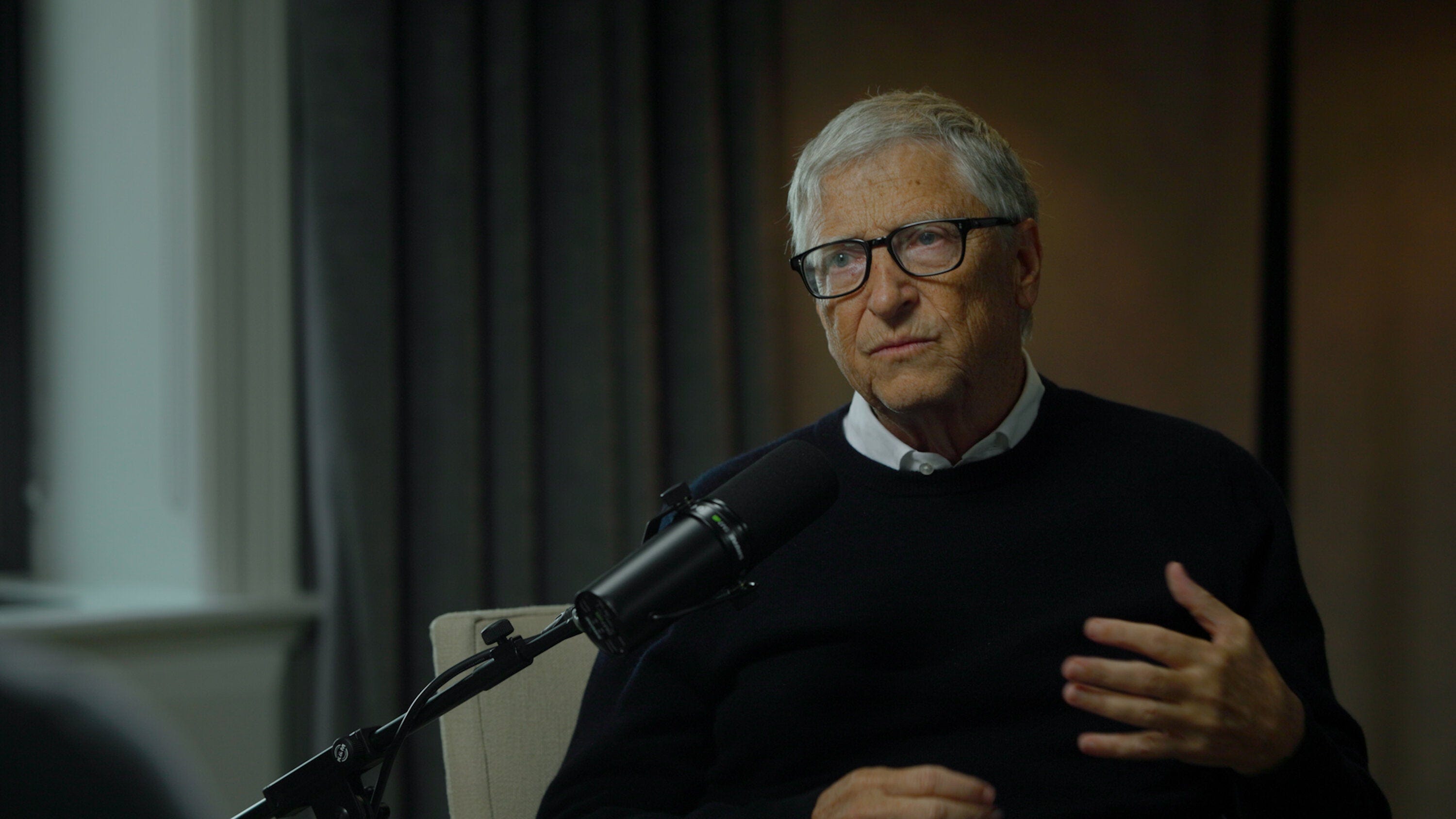
Bill Gates has become considerably more worried about artificial intelligence. That shift is notable because Gates is not an instinctive technological pessimist. He built one of the most important technology companies in history and still believes AI could improve medicine, education, scientific research and living standards on an extraordinary scale. Yet in a recent essay and an interview with Ezra Klein, Gates described a technology that he believes is approaching, and in some cases has already crossed, thresholds for which governments and societies are badly prepared.
The easiest way to understand his argument is this: Intelligence has always been expensive because it required a trained human being. If you wanted medical expertise, you needed a doctor. If you wanted sophisticated software, you needed a programmer. If you wanted advanced scientific knowledge, you needed a scientist. Gates thinks AI could make many forms of intelligence cheap, abundant and widely available.
That could be extraordinarily good.
It could also be extraordinarily dangerous.
For the moment, humans still have an advantage. AI makes mistakes. It needs supervision. It often performs parts of a job rather than the entire job. Gates acknowledges that AI has not yet produced the mass unemployment he thinks could eventually follow. His argument is that this balance depends on machines remaining less capable or less reliable than people in important ways. Once that changes, he believes the economics can change very quickly.
Consider customer service. A company can use AI to handle routine questions today, but if the system still makes enough mistakes, people must remain behind it. Now imagine a system that answers more accurately than the average employee, knows every company policy, speaks every major language, works continuously and costs a fraction as much as a human worker. At some point, the fact that a person used to perform the job may stop carrying much economic weight.
The same thought experiment becomes more uncomfortable in professions we tend to regard as distinctly human. Imagine calling an AI nurse at three in the morning. It has your complete medical history. It remembers every previous conversation. It has access to more medical knowledge than any individual clinician could retain. It does not hurry because another patient is waiting and does not become exhausted at the end of a shift. If such a system eventually became demonstrably better than the average human at particular kinds of care, Gates doubts that people would indefinitely insist on a human simply because the alternative was a machine.
This is one of his more provocative claims. People often assume there will always be jobs protected by a preference for human beings: a nurse caring for us, a therapist listening to us, a driver taking us home, a teacher instructing our children. Gates’s response is that this preference may itself depend on quality. We may prefer the human while the human offers the better experience. What happens when the machine becomes substantially better, always available and dramatically cheaper?
That is still a prediction, not an established fact. People may continue to value human interaction even when AI performs better on measurable dimensions. But Gates sees early examples, including autonomous driving and AI-mediated services, as evidence that preferences can change once machine performance becomes good enough.
The economic pressure would not necessarily depend on anyone wanting to replace workers. Gates uses insurance claims as an example. Imagine one insurer employing thousands of people to review claims while another can perform essentially the same work more accurately with AI and a much smaller staff. The second company may be able to charge less. The first company does not need to dislike human workers to automate their jobs. Competition may do the work for it.
This is why Gates believes AI could differ from earlier technological revolutions. Tractors displaced agricultural workers, but people moved into factories. Factory automation displaced some industrial workers, but services expanded. Computers eliminated clerical work while creating demand for programmers, managers and designers. Human intelligence was still something machines could not replace.
Gates is asking what happens when that is no longer true.
An AI system does not sleep. It can process more information than a human could read in a lifetime. It can operate in many languages, be copied almost instantly and potentially perform enormous numbers of similar tasks at once. If AI eventually becomes capable of completing whole cognitive jobs rather than merely assisting with pieces of them, Gates argues, there may be no obvious higher category of work for displaced people to move into.
This is also why he is skeptical of one of the traditional arguments against technological unemployment. Economists often point out that when technology makes something cheaper, people consume more of it. If AI makes programmers three times as productive, businesses may simply build much more software and continue employing programmers.
Gates accepts that logic while humans remain necessary. But if AI can eventually complete the entire task on its own, increased demand does not necessarily produce increased human employment. In his interview with Klein, he put the distinction bluntly: the extra spending goes into the “token budget,” not the “human salary budget.” In plain English, the company spends more on computing power instead of hiring more people.
That prediction remains uncertain. We do not yet have an economy in which AI can reliably perform most human cognitive jobs from beginning to end. New forms of work may appear. Demand may expand in ways Gates underestimates. People may value human relationships and human judgment more than markets alone would suggest. Gates himself has proposed preserving certain categories of work as “Human Reserved,” including parts of caregiving, education and medicine, even if machines eventually become cheaper or more capable.
But that proposal reveals how far his argument goes. If society eventually needs to reserve certain jobs for people because the market no longer requires a person, that would represent something fundamentally different from previous automation. Human intelligence would not have lost its moral or social value. It would have lost some of its economic scarcity.
The same idea, intelligence becoming cheaper and more widely available, also explains why Gates is worried about security.
Cybersecurity is the clearest case. A sophisticated cyberattack once required sophisticated people. Expertise acted as a barrier. The British government’s AI Security Institute has documented rapid improvements in the most advanced AI systems on cyber tasks, including work that only recently would have required highly experienced specialists. AI-assisted malicious cyber activity is already occurring, and the systems are becoming capable of completing longer and more complicated technical tasks without continuous human help.
That does not mean AI can autonomously shut down a country’s power grid today. But it changes the economics of attack. Smaller groups can potentially accomplish more. Less-skilled attackers can borrow capabilities they do not personally possess. A task that once required a team of experienced hackers may eventually require fewer people.
Cyber is therefore the part of Gates’s warning that requires the least imagination. The dangerous capability is not hypothetical. It is already appearing, even if the most catastrophic scenarios remain uncertain.
Biology is more complicated.
Gates has argued that AI has crossed an important biological threshold and can now significantly increase the danger posed by malicious actors. There is evidence behind the concern. The most advanced AI systems increasingly perform at or above expert level on some biology and chemistry tests. They can help plan experiments and can sometimes help scientists figure out why an experiment failed. Those capabilities suggest that some of the knowledge barriers that historically limited sophisticated biological research are weakening.
But Gates is more confident here than the evidence currently allows.
A model being very good at biology is not the same thing as a terrorist being able to create a catastrophic pathogen. Biological work still requires materials, equipment, practical skill and the ability to make experiments work in the physical world. The most comprehensive current assessments continue to describe substantial uncertainty about how much AI actually increases real-world biological-weapons capability.
The risk becomes more plausible, however, once the imagined attacker is not an amateur.
A malicious actor could already be a trained scientist. That person might already work in a laboratory, have legitimate access to equipment and materials and possess years of experience. In that case, AI does not need to turn a novice into a world-class biologist. It only needs to fill gaps in an expert’s knowledge.
That is a much more credible threat model. It is also why Gates’s concern should not be dismissed simply because the strongest version of his claim runs ahead of the evidence. AI is clearly lowering some barriers to advanced biological work. What remains uncertain is whether enough of those barriers have fallen to make catastrophic biological misuse substantially more achievable today.
This difference between cyber and biology matters. Gates often discusses them together, but they are not equally mature threats. Cyber is already an observed misuse problem. Bio is a serious emerging risk inferred partly from rapidly improving capabilities.
The distinction also helps explain Gates’s most dramatic comparison. In his interview with Klein, he said AI could make nuclear weapons “look like nothing.”
Taken literally, that is difficult to defend. Nuclear weapons can destroy cities within minutes, and a large-scale nuclear war could kill billions of people. Gates’s broader argument, however, appears to be less about the destructive force of a single weapon than about how easily dangerous capabilities can spread.
Nuclear weapons are extraordinarily difficult to build. The necessary materials are scarce, the infrastructure is conspicuous and governments have spent decades creating treaties, inspections, export controls and intelligence systems designed to limit their spread. AI has very different characteristics. Once a powerful model exists, its capabilities can in principle be shared far more widely and used again at very little additional cost.
AI is also general-purpose. A nuclear weapon performs one devastating function. A sufficiently capable AI system might strengthen cyberattacks, biological research, surveillance, fraud, autonomous weapons and other forms of coercion at the same time. The useful and dangerous applications are often inseparable. A system capable of finding software vulnerabilities can help defend a network or attack it. A model capable of sophisticated biological reasoning can help develop medicines or potentially assist harmful research.
That helps explain why Gates sees AI as unusually difficult to contain. The world eventually built elaborate institutions around nuclear technology. Nothing comparable yet exists around AI, and the technology is developing largely in private companies rather than inside government weapons programs.
Still, Gates is not primarily warning about a future superintelligent AI escaping from human control. That puts him at some distance from one of the most familiar arguments in AI safety.
Some researchers are especially worried about what is called recursive self-improvement. The basic idea is simple: AI systems become capable enough to help design better AI systems, which then help design even more capable ones. If that process accelerated dramatically, AI might improve faster than humans could understand or control it.
Related to that is the “control problem”: the possibility that AI eventually becomes so capable and autonomous that humans can no longer reliably direct it, constrain it or shut it down.
Klein raised this possibility directly. Gates did not dismiss it. He called the control problem serious and acknowledged that sufficiently advanced systems could eventually act against human interests.
But he drew a clear distinction.
“The control problem is a serious problem,” Gates said, “but the imminent risk is not RSI.”
That sentence captures much of his worldview. Gates does not appear to think artificial superintelligence, meaning AI that greatly exceeds humans across most intellectual abilities, is harmless or irrelevant. He thinks it is a more distant concern and requires more uncertain steps.
His nearer-term scenario is simpler.
The AI becomes powerful, and a person uses it badly.
The people already exist. The computer networks already exist. The laboratories already exist. So do governments, corporations, criminal organizations and political movements with their own goals. Gates’s argument is that AI does not need intentions of its own to amplify theirs.
That is why he can sound more alarmed than many technologists while remaining less preoccupied with superintelligence than some AI-safety researchers. He is not saying humanity will never face a control problem. He is saying that severe AI-driven problems may arrive while humans remain completely in control of the machines.
His proposed response follows from that diagnosis. Gates is not calling for an end to AI development. He wants stronger government oversight, monitoring of powerful models, safeguards that users cannot simply remove and controlled access to capabilities that could be dangerous if universally available. His skepticism toward industry self-regulation comes from the belief that the costs of misuse would be borne by people far beyond the companies developing the systems.
He is also skeptical of framing the entire issue as a race in which the United States must defeat China. Gates has questioned what it would mean for either country to “win” if dangerous capabilities eventually spread. A biological outbreak would not respect national borders. A cyberattack on globally interconnected systems could have consequences well beyond the country where it began. Competition between the United States and China, in his view, does not eliminate their shared interest in preventing certain catastrophic uses.
There are good reasons not to accept all of Gates’s conclusions. AI progress could slow. Reliability may prove harder than expected. Defensive cyber systems may improve alongside offensive ones. Biological safeguards may become much stronger. Economies may generate new forms of work that Gates cannot foresee. Consumers may continue to value human beings even when machines outperform them on measurable dimensions.
Most importantly, greater capability does not tell us exactly what the consequences will be. If AI becomes better, cheaper and more reliable than humans at performing an entire job, significant job displacement becomes a very reasonable expectation, though we still cannot know how much new demand or new work might offset it. In biology, increasingly sophisticated AI makes dangerous misuse more plausible, but it does not by itself overcome the physical barriers involved in successfully creating and deploying a biological weapon. And in cybersecurity, more capable AI strengthens attackers while also giving defenders more powerful tools. The capabilities matter enormously. What remains uncertain is how markets, institutions, defenses and human behavior respond to them.
This is where the evidence both supports and limits Gates’s case.
He is strongest when describing the direction in which AI capabilities are moving. Those changes are measurable. AI systems are becoming better at software, scientific reasoning, cyber operations and increasingly long autonomous tasks. Human expertise is becoming easier to reproduce in machine form.
He becomes less certain when he predicts exactly what happens next.
On cyber, his concern is strongly grounded in developments already underway. On biology, the concern is real but his claim that the decisive threshold has already been crossed is stronger than the evidence currently supports. On jobs, the mechanism is plausible but the final economic outcome remains deeply uncertain. On superintelligence and loss of control, Gates sees a serious long-term problem, just not the one he thinks will arrive first.
His nuclear comparison is best understood in the same way. It is less a literal claim about explosive power than an argument about how widely dangerous capability can spread. Nuclear technology concentrated extraordinary destructive power in a small number of hands. AI could make powerful forms of intelligence cheap, replicable and widely available.
That possibility cuts both ways.
Cheap intelligence could accelerate scientific discovery, expand access to medicine and education, strengthen cybersecurity and allow people everywhere to accomplish things that once required enormous amounts of money, training or institutional access. Gates still believes deeply in that future.
But the same abundance could change what a hacker can do, what a malicious scientist can do and what employers still need people to do.
For most of history, if you wanted intelligence, you needed a person.
Gates’s warning is about what happens when you no longer do.
Evidence & Source Transparency
Evidence First shows its work. The article ends above; this section is included so readers can inspect the main sources behind the factual claims.
The list below does not source every sentence. It focuses on the factual claims most important to the argument.
1. Gates’s argument about human intelligence, jobs and AI
Claim or topic:
Bill Gates argues that AI could reduce the economic scarcity of human intelligence as systems become more capable, reliable and inexpensive. He has discussed the possibility of significant job displacement, the importance of crossing a reliability threshold, the shift from a “human salary budget” toward a “token budget,” and preserving some roles as “Human Reserved.”
Source:
Bill Gates, “The turbulent AI era is here. The choices we make now are critical.”
Bill Gates interview on The Ezra Klein Show, transcript
Source type:
Primary essay and transcript of primary interview.
What it supports:
These sources support Gates’s stated concern that increasingly capable AI could perform work now done by humans, his emphasis on reliability as an important threshold, his discussion of computing spending replacing some human labor spending, and his proposal to preserve some activities for humans even if machines become capable of doing them.
Important caveat:
These are Gates’s arguments and predictions about future economic effects. They establish what Gates believes, not that widespread permanent job loss will necessarily occur.
2. Rapid improvement in AI cybersecurity capabilities
Claim or topic:
Advanced AI systems have improved substantially at cybersecurity tasks, including increasingly difficult tasks that previously required significant human expertise.
Source:
UK AI Security Institute, Frontier AI Trends Report
Source type:
Government research and technical evaluation.
What it supports:
The report documents substantial improvements in AI performance on cybersecurity evaluations, including success on increasingly difficult tasks and longer sequences of work completed with less human assistance. It supports the article’s claim that the cyber capability trend is already measurable rather than purely hypothetical.
Important caveat:
Performance on controlled cybersecurity evaluations does not establish that AI can autonomously carry out the most catastrophic real-world attacks. Defensive AI capabilities are also improving.
3. AI capabilities in biology
Claim or topic:
The most advanced AI systems are becoming increasingly capable at biological reasoning, experimental planning and laboratory troubleshooting.
Source:
UK AI Security Institute, Frontier AI Trends Report
Source type:
Government research and technical evaluation.
What it supports:
The report supports the article’s description of advanced models performing at or above expert level on some biology-related evaluations, producing useful experimental guidance and performing strongly on laboratory troubleshooting tasks.
Important caveat:
These evaluations measure components of biological expertise. They do not demonstrate that an AI user can successfully create or deploy a catastrophic biological weapon.
4. Uncertainty about real-world AI-enabled biological weapons risk
Claim or topic:
Although AI is lowering some knowledge barriers in biology, it remains uncertain how much this increases the practical ability of malicious actors to create biological weapons.
Source:
International AI Safety Report 2026
Source type:
Expert organization and international scientific assessment.
What it supports:
The report supports the distinction made in the article between improving biological capabilities and successful real-world misuse. It discusses continuing barriers including materials, equipment, experimental execution and other practical constraints, while also treating biological misuse as a serious emerging risk.
Important caveat:
The report does not establish that Gates’s proposed biological “threshold” has definitively been crossed. It emphasizes substantial uncertainty about the translation from benchmark performance to real-world biological-weapons capability.
5. Gates on recursive self-improvement and the control problem
Claim or topic:
Gates considers loss of control over highly advanced AI a serious concern, but he places greater emphasis on human misuse in the nearer term and said that “the imminent risk is not RSI.”
Source:
Bill Gates interview on The Ezra Klein Show, transcript
Source type:
Transcript of primary interview.
What it supports:
The interview directly supports the article’s description of Gates distinguishing between the longer-term AI control problem and more immediate risks involving humans using powerful AI systems for harmful purposes.
Important caveat:
Gates does not dismiss artificial superintelligence or loss of control. The article therefore presents his position as a difference in priority and timing, not as a rejection of those risks.
6. Gates’s comparison between AI and nuclear weapons
Claim or topic:
Gates has used unusually strong language comparing AI risk with nuclear weapons, including saying that AI could make nuclear weapons “look like nothing.”
Source:
Bill Gates interview on The Ezra Klein Show, transcript
Source type:
Transcript of primary interview.
What it supports:
The source supports the article’s account of Gates making the nuclear comparison and presenting AI as an unusually broad and difficult-to-govern source of risk.
Important caveat:
The article’s interpretation that the comparison is largely about accessibility, proliferation and difficulty of containment draws on Gates’s broader argument. The interview does not establish that a single AI-enabled attack would literally be more destructive than a nuclear weapon.
7. Gates on safeguards, government oversight and China
Claim or topic:
Gates argues for stronger safeguards around powerful AI systems, greater government involvement and some degree of international cooperation, including between the United States and China, on risks that cross national borders.
Source:
Bill Gates, “The turbulent AI era is here. The choices we make now are critical.”
Bill Gates interview on The Ezra Klein Show, transcript
Source type:
Primary essay and transcript of primary interview.
What it supports:
These sources support Gates’s calls for stronger oversight, restrictions or safeguards around particularly dangerous capabilities, and his argument that some AI risks cannot be understood solely as a competition in which one country “wins.”
Important caveat:
These are Gates’s policy judgments. The sources establish his position, not that the safeguards he proposes will be sufficient or that meaningful international cooperation will be achievable.
How to read this evidence
This article is the author’s analysis. The sources above are provided so readers can see where the factual claims come from and judge the evidence for themselves. Some sources support direct facts, while others provide context, estimates, or background evidence.
Production transparency
Evidence First uses artificial intelligence extensively for research, analysis, drafting, and editing. AI may generate substantial portions of the written article. Human editorial judgment determines the questions investigated, evaluates the evidence and competing explanations, reviews important factual claims and sources, determines what conclusions the evidence supports, and approves the article for publication. AI-generated statements are not treated as evidence; conclusions must be supported by the cited sources.
Corrections and updates
If a factual error is identified, this post will be corrected in the web version with a dated note explaining the change. Because email versions cannot be edited after sending, the web version should be treated as the current version.