


The argument often starts with a list.
A senator, a movie producer, a university president, a financier. The names are assembled, their Jewish backgrounds highlighted, and a question follows: How can a group that makes up only a small percentage of the country appear so frequently in prominent positions?
There is a factual observation buried inside that question. Jewish Americans constitute about 2.4 percent of the adult population, according to the Pew Research Center, yet they are represented at higher rates in at least some influential institutions. In the 119th Congress, for example, 32 members identify as Jewish, about 6 percent of Congress. Nine percent of senators are Jewish.
The history of Hollywood offers another conspicuous example. The Academy Museum of Motion Pictures describes the studio system as having been established largely by Jewish immigrant filmmakers and entrepreneurs. Their companies helped turn Los Angeles into the center of the American movie industry.
But from there, discussions often move too quickly. A measurable difference in representation becomes a sweeping assertion about “power.” Then representation is treated as evidence of “control.” Finally, the actions of individual politicians, executives, or artists are attributed to Jews collectively.
That final step is the crucial one. Antisemitic theories of Jewish power have historically depended not simply on the idea that individual Jews are successful or influential, but on the claim that Jews act collectively, coordinating behind the scenes to advance shared interests or control institutions. The demographic evidence examined here cannot establish such coordination. To demonstrate collective control would require evidence of common objectives, communication, and coordinated action, not simply a list of people who share a background.
Each step introduces a new claim. Each requires new evidence.
The available evidence supports a complicated history of disproportionate achievement in certain fields. It does not support the idea of a unified Jewish project to direct American institutions.
A Number That Does Not Exist
One difficulty is that there is no comprehensive count of Jewish Americans in “positions of power.”
The phrase itself has no agreed definition. Does it include elected officials, judges, and cabinet secretaries? Corporate chief executives and board members? Billionaires, newspaper editors, university trustees, television producers, physicians, and law firm partners? How should their influence be measured and compared?
The federal government cannot supply the answer. The Equal Employment Opportunity Commission requires many large employers to report workers by job category, sex, race, and ethnicity, but not by religion. The decennial census also does not ask Americans to identify their religion. As a result, federal data do not provide the kind of religious workforce tables that would allow researchers to calculate the Jewish share of corporate leadership across the economy.
Jewish identity is also unusually difficult to classify from the outside. It can refer to religion, ancestry, ethnicity, culture, or some combination of them. Pew counts people who identify Judaism as their religion, as well as people with no religion who nevertheless identify as Jewish and have a Jewish parent or were raised Jewish. But Jewish ancestry alone is not enough. Someone may have a Jewish parent or grandparents and still fall outside Pew’s estimate if they do not identify as Jewish themselves.
Those definitional difficulties do not mean the overall population estimate is arbitrary. A separate research project at Brandeis University, the American Jewish Population Project, has produced a broadly similar estimate of the size of the American Jewish population using a different methodology. The project combines data from many national surveys rather than relying on a single Jewish population survey. The fact that different methods produce similar overall estimates provides some reassurance about the approximate size of the population, although the projects do not define or measure every category in exactly the same way.
What those estimates cannot do, however, is turn surnames or internet biographies into a reliable census of Jewish influence. Lists assembled from surnames, grandparents, or internet biographies therefore cannot provide a reliable census. They may count secular people as representatives of a religion they do not practice, omit converts or people with less recognizable names, and change the definition of Jewishness from one person to another.
Even apparently precise statistics can create a different problem: confusing the numerator and denominator. Pew found, for example, that 11 percent of employed Jewish respondents worked in a broad category covering arts, entertainment, recreation, travel, accommodations, and food service. That does not mean Jews constitute 11 percent of the entertainment industry. It means 11 percent of the Jewish workers surveyed were employed somewhere inside that very broad collection of industries.
The distinction is elementary, but it is frequently lost when demographic claims circulate online.
The Education Pipeline
Where disproportionate representation does exist, education provides the clearest immediate explanation.
In Pew’s 2023 to 2024 Religious Landscape Study, 65 percent of Jewish adults had at least a bachelor’s degree, compared with 35 percent of American adults overall. Jewish Americans and Hindus were the country’s two most highly educated major religious populations by that measure.
That difference matters because many jobs associated with influence are drawn from a narrow educational pipeline. Law, medicine, finance, academic research, senior government service, and corporate management usually require a university degree, and often an advanced one. A population with nearly twice the national college graduation rate will enter the pool of candidates for such positions at a disproportionately high rate, even before hiring preferences or professional networks are considered.
Education, however, is an immediate mechanism rather than a complete historical explanation. It raises another question: Why did educational and professional attainment become so pronounced?
Part of the answer lies in migration and geography.
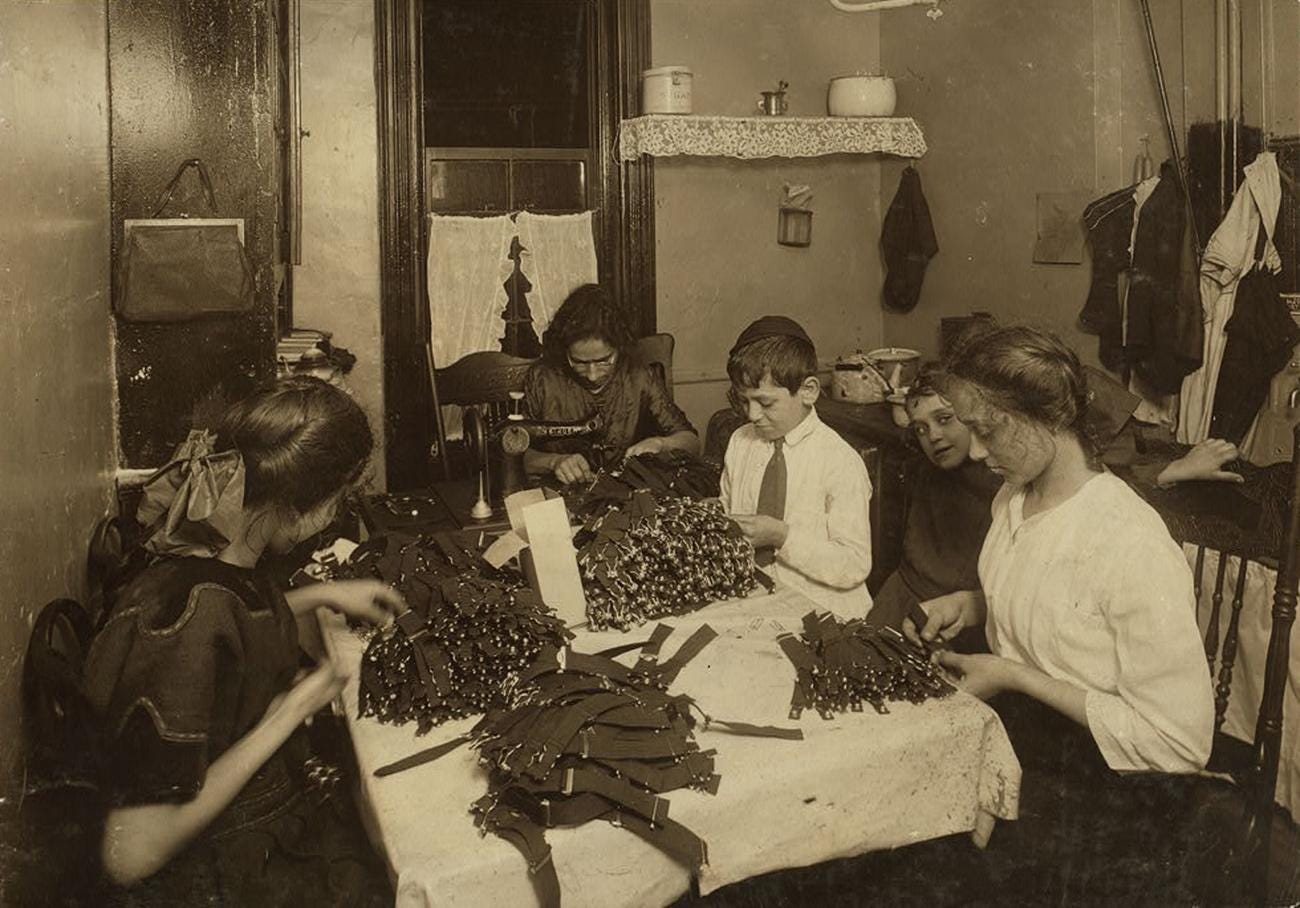
Roughly two million Jews arrived in the United States from Europe during the age of mass migration in the late 19th and early 20th centuries, many fleeing persecution and seeking economic opportunity. Economic historians using census records found that Jewish immigrants were concentrated in urban, semi-skilled occupations rather than agricultural labor. Many lived in overcrowded and impoverished enclaves, particularly in New York, but their occupations often supplied skills that could be transferred to commerce, manufacturing, and professional life in a rapidly urbanizing economy.
The distinction is important. These immigrants did not generally arrive as a wealthy ruling class. Many worked in garment shops, small stores, and crowded tenements. But their location in cities and their concentration in occupations connected to commerce placed them differently from immigrant populations whose economic lives were centered on farming or unskilled rural labor.
Later generations inherited not merely money, since many families had little, but also information, expectations, occupational knowledge, and proximity to expanding institutions.
Exclusion and the Building of New Institutions
Jewish advancement also occurred alongside discrimination, not in its absence. Anti-Jewish prejudice in America long predates the university quotas and professional barriers of the 20th century. By the early 1900s, some of that exclusion had become embedded in elite educational and professional institutions.
Universities imposed formal or informal barriers. Elite social clubs and old professional networks frequently excluded Jews. A study of Harvard students in the 1920s and 1930s found that students with distinctively Jewish surnames made up 6.6 percent of the student body but just 0.2 percent of the membership in selective final clubs.
Those clubs were not merely social diversions. Membership was associated with much higher later earnings and a substantially greater likelihood of entering finance. The findings illustrate how elite networks could shape careers independently of academic achievement, and how Jewish students could be admitted to a prestigious university while remaining outside some of its most consequential social circles.
Exclusion closed doors and imposed real costs. In some cases, it also encouraged Jewish entrepreneurs and professionals to build businesses, cultural institutions, and networks outside older establishments.
Hollywood is the most famous case. Many of the industry’s founders were Jewish immigrants or the children of immigrants. They entered a young and disreputable business that was not yet guarded by the same established elites that dominated older industries. The studios they created eventually became among the country’s most influential cultural institutions.
There is an irony in that history. People partly shut out of existing centers of prestige helped build new ones. Later generations encountered the outcome, a visible concentration of Jewish names in entertainment, without necessarily seeing the migration, exclusion, entrepreneurship, and decades of institutional development that preceded it.
The Familiarity Effect
Another part of the explanation may be more ordinary.
People tend to know, trust, and refer people who resemble those already in their social worlds. Social scientists call this “homophily,” a term meaning that relationships often form among people with similar backgrounds, experiences, or identities.
A 2025 field study of job referrals, for example, found that men and women were much more likely to refer candidates of their own gender. The researchers concluded that the pattern was driven largely by the gender composition of close friendship networks. The participants did not need to belong to a coordinated campaign. They referred people they knew, and the people they knew tended to resemble them.
Similar dynamics can operate through families, neighborhoods, colleges, religious communities, professional associations, and former workplaces. A manager may call a trusted former colleague. An employee may recommend a friend from school. A producer may hire a writer with whom she has previously worked. A senior professional may mentor a younger person whose background feels familiar.
Such choices can reproduce a group’s representation over time, even when no one explicitly intends to exclude outsiders.
It is therefore reasonable to suspect that Jewish social and professional networks have sometimes helped Jewish candidates, just as alumni networks, family connections, church communities, ethnic associations, and old boys’ clubs have helped members of many other groups.
But a plausible general mechanism is not the same as a demonstrated group-specific explanation. There is no comprehensive evidence showing how frequently Jewish decision-makers favor Jewish applicants or how much such preferences contribute to Jewish representation in business, entertainment, or government.
The relevant affinity may not even be religion. People who appear to be choosing “people like themselves” may actually be selecting for the same university, neighborhood, class background, profession, political outlook, or style of communication. These characteristics frequently overlap, making their individual effects difficult to separate.
The careful conclusion is that in-group networking probably occurs sometimes, among Jews as among other populations. Its scale is unknown. Nothing about the mechanism requires a coordinated ethnic objective.
Representation Is Not Control
The difference between representation and control is the central evidentiary question.
A population can be disproportionately represented without acting collectively. A university may have many Jewish professors who disagree about politics, religion, university policy, and Israel. A movie studio may employ Jewish executives who compete against one another. Jewish members of Congress may vote differently because of party, ideology, constituency, or personal judgment.
American Jews are themselves politically and religiously diverse. Pew found that the population overall leaned strongly Democratic, while Orthodox Jews were a notable exception and leaned heavily Republican. Reform, Conservative, Orthodox, and unaffiliated Jews also expressed sharply different attitudes on religious and political questions.
When we asked Leonard Saxe, a Brandeis social psychologist who studies American Jewish life, about this piece, he pointed to a dark irony in the idea of seamless Jewish coordination. Jewish culture, he noted, has an old joke: “2 Jews, 10 opinions.”
Anyone familiar with Jewish communal life will recognize the point. Coordinating millions of Jews around a single hidden agenda would require overcoming an impressive amount of disagreement first. Humor aside, the underlying point is measurable: American Jews differ substantially in religious practice, politics, ideology, and attitudes toward Israel. Shared identity is not evidence of shared intent.
To establish collective control, evidence would have to show more than identity or presence. It would need to identify who possesses actual decision-making authority, demonstrate communication or coordination, establish shared objectives, and connect that coordination to institutional decisions.
A roster of names does none of those things.
The same reasoning would apply to any group. A large number of Catholics on the Supreme Court would not, by itself, prove that Catholics secretly coordinate judicial decisions. A high percentage of Protestants in Congress would not establish unified Protestant control of the government.
Indeed, Jewish Americans are not the only religious group overrepresented in Congress. In the 119th Congress, Protestants make up about 55 percent of members, compared with 40 percent of American adults. Christians overall constitute 87 percent of Congress but approximately 62 percent of the adult population. Meanwhile, religiously unaffiliated Americans make up more than a quarter of the population but less than 1 percent of Congress.
Political institutions rarely mirror the population perfectly. Education, age, geography, wealth, social networks, party recruitment, and voters’ preferences all shape who reaches office.
Why the Leap Matters
Claims of collective Jewish control are not merely inaccurate descriptions of demographics. They belong to a longstanding form of conspiracy thinking: the idea that visible events are secretly directed by a powerful and concealed group.
Psychological research has found that conspiracy theories about social groups are associated with prejudice and discrimination. A major review of the field concluded that antisemitic conspiracy beliefs predict broader hostility toward Jews and discriminatory intentions. Experimental research has also found that exposure to intergroup conspiracy theories can increase prejudice.
It is also important not to mistake antisemitic conspiracy beliefs for the dominant American attitude toward Jews. Pew has repeatedly found Jews to be among the most positively viewed religious groups in the United States. In a 2023 survey, Jews were the only religious group to receive net-positive ratings from every other religious group with enough respondents to measure. Antisemitism can therefore coexist with broadly favorable attitudes toward Jews, which is another reason to distinguish specific conspiracy beliefs from general public sentiment.
The danger lies partly in the theory’s flexibility. Successful Jewish individuals are counted as evidence of control. Jews who disagree with one another are treated as camouflage. A lack of direct evidence becomes proof that the supposed conspiracy is secretive. The claim becomes impossible to disprove because every possible observation is absorbed into it.
This does not mean that institutions should be shielded from scrutiny. Concentrated ownership, nepotism, lobbying, campaign spending, conflicts of interest, and exclusionary hiring practices are legitimate subjects of investigation.
But those questions are best pursued through evidence about conduct and institutional structure.
Who owns the voting shares? Who made the hiring decision? Were similarly qualified applicants treated differently? Which lobby spent what amount on which issue? What authority did an executive actually exercise? Was there documented communication or coordination?
These are answerable questions. “Which ethnic group do these people belong to?” is usually not an adequate substitute.
A More Honest Way to Talk About Power
A productive discussion can acknowledge several things at once.
Jewish Americans are disproportionately represented in some prominent institutions. High educational attainment, urban migration, occupational history, entrepreneurship, adaptation to exclusion, and intergenerational networks all offer evidence-based parts of the explanation. Familiarity and in-group referrals may sometimes reinforce existing patterns, though their specific contribution has not been measured adequately.
None of this proves that representation is entirely meritocratic. No institution operates free from personal connections, inherited advantages, or bias. Nor does it prove that Jewish professionals never favor relatives, friends, or members of their communities. Members of every population are capable of favoritism.
But individual favoritism is not collective control. A recurring social tendency is not an ethnic plot. A demographic pattern does not reveal the intentions of every person counted inside it.
Research on correcting misinformation suggests that rebuttals are more effective when they do more than label a claim false. They should explain what is wrong and provide a better account of the evidence.
Here, the better account is not mysterious.
A small immigrant population became heavily urban, invested strongly in education, entered particular professions, built institutions when older ones excluded it, and transmitted professional knowledge and networks across generations. Those advantages sometimes compounded, as advantages often do. The result was disproportionate representation in some highly visible fields, alongside considerable diversity, disagreement, and ordinary life among millions of Jewish Americans who hold no unusual power at all.
That history is complicated. A conspiracy is simpler.
But the simpler story is not the truer one.
Evidence & Source Transparency
Evidence First shows its work. The article ends above; this section is included so readers can inspect the main sources behind the factual claims.
The list below does not source every sentence. It focuses on the factual claims most important to the argument.
1. Jewish population size and representation in Congress
Claim or topic:
Jewish Americans make up about 2.4 percent of U.S. adults and are represented at a higher rate in Congress, including roughly 6 percent of the 119th Congress.
Source:
Pew Research Center, “The Size of the U.S. Jewish Population”
Brandeis University, American Jewish Population Project, “U.S. Jewish Population Estimates 2020”
Pew Research Center, “Faith on the Hill: The Religious Composition of the 119th Congress”
Source type:
Expert organizations; demographic survey research, statistical population estimation, and analysis of congressional membership.
What it supports:
Pew estimated that Jewish adults made up about 2.4 percent of the U.S. adult population in 2020. Pew identified 32 Jewish members of the 119th Congress, about 6 percent of Congress, including nine senators. Brandeis University’s American Jewish Population Project produced a broadly similar estimate of the total American Jewish population using a different methodology based on combining data from many surveys.
Important caveat:
Pew and the Brandeis project use different methodologies and do not define or estimate every component of the Jewish population in exactly the same way. Their similar overall estimates provide useful corroboration, but they should not be treated as identical measurements.
2. Jewish identity and the limits of federal demographic data
Claim or topic:
Jewish identity cannot be determined reliably from ancestry or surnames alone, and federal data do not provide a comprehensive count of Jewish Americans across occupations or leadership positions.
Source:
Pew Research Center, “Jewish Americans in 2020”
U.S. Equal Employment Opportunity Commission, EEO Data Collections
U.S. Census Bureau, FAQs for Faith-Based Communities
Source type:
Expert-organization survey research and government data.
What it supports:
Pew distinguishes between people who identify Judaism as their religion and people with no religion who identify as Jewish and meet additional background criteria. Jewish ancestry alone does not automatically place someone in Pew’s Jewish population. Federal employment reporting includes categories such as race, ethnicity, sex, and job category, but not religion, and the decennial census does not collect religious affiliation.
Important caveat:
These sources explain why a comprehensive national religion-based workforce count is unavailable. They do not establish that no private, academic, or industry-specific estimates exist for particular occupations or institutions.
3. Educational attainment
Claim or topic:
Jewish Americans have unusually high levels of educational attainment, which is relevant to their representation in professions requiring university or postgraduate credentials.
Source:
Pew Research Center, “Which U.S. Religious Groups Are Most Highly Educated?”
Source type:
Expert organization; national survey analysis.
What it supports:
Pew’s 2023 to 2024 Religious Landscape Study found that 65 percent of Jewish adults had at least a bachelor’s degree, compared with 35 percent of U.S. adults overall.
Important caveat:
The education difference does not by itself establish why Jewish educational attainment is high or how much education explains Jewish representation in any particular profession or institution.
4. Immigration, occupations, and economic mobility
Claim or topic:
Jewish immigrants during the era of mass migration were heavily urban and concentrated in skilled and semi-skilled occupations, factors relevant to subsequent economic mobility.
Source:
National Bureau of Economic Research, research on Jewish economic mobility in the United States
Source type:
Academic research; economic history using historical census data.
What it supports:
The research supports the article’s discussion of the occupational position, urban concentration, and economic advancement of Jewish immigrants and their descendants.
Important caveat:
The research does not by itself establish every historical claim in this section or provide a single causal explanation for later Jewish achievement. Source needed: The article’s specific statement that roughly two million Jews arrived in the United States from Europe during the late 19th and early 20th centuries should have a source that directly establishes that immigration estimate.
5. Anti-Jewish discrimination and exclusion from elite institutions
Claim or topic:
Anti-Jewish prejudice in America predates 20th-century university discrimination, and Jewish students were later sharply underrepresented in some elite social networks despite attending prestigious universities.
Source:
Pamela S. Nadell, Antisemitism, an American Tradition
The Quarterly Journal of Economics, study of Harvard social networks and later outcomes
Source type:
Historical scholarship and peer-reviewed academic research.
What it supports:
Nadell’s historical work traces anti-Jewish prejudice and discrimination in America back to the colonial period. The Harvard study found that students with distinctively Jewish surnames were substantially underrepresented in selective final clubs during the period examined and that club membership was associated with later economic and professional advantages.
Important caveat:
The Harvard evidence concerns one university and one historical period. It illustrates how exclusionary elite networks could operate, but it does not establish that such exclusion alone explains subsequent Jewish professional success.
6. Jewish involvement in the development of Hollywood
Claim or topic:
Jewish immigrants and their children played an unusually important role in building the early Hollywood studio system.
Source:
Academy Museum of Motion Pictures, “Hollywoodland”
Source type:
Expert organization; historical synthesis.
What it supports:
The Academy Museum describes the early Hollywood studio system as having been established largely by Jewish immigrant filmmakers and entrepreneurs.
Important caveat:
Historical prominence in the founding of the studio system does not establish the current proportion of Jewish executives or creators in entertainment, nor does it demonstrate coordinated decision-making among Jewish individuals.
7. Social networks, referrals, and homophily
Claim or topic:
Social networks and similarity-based referrals can reproduce demographic patterns without centralized planning or explicit coordination.
Source:
Labour Economics, research on gender homophily in job referrals
Source type:
Academic research; field study.
What it supports:
The study found that men and women were more likely to refer candidates of their own gender and linked much of that pattern to the composition of close friendship networks. It supports the article’s discussion of homophily as a general social mechanism.
Important caveat:
The study examined gender, not Jewish hiring or Jewish professional networks. It supports the plausibility of the general mechanism, not the magnitude of its contribution to Jewish representation in any particular field.
8. Conspiracy beliefs, prejudice, and broader attitudes toward Jews
Claim or topic:
Conspiracy beliefs about social groups are associated with prejudice and discriminatory attitudes, while Americans overall can simultaneously hold broadly favorable views of Jews.
Source:
Annual Review of Psychology, review of conspiracy theories and their consequences
Source type:
Peer-reviewed academic review and expert-organization survey research.
What it supports:
The psychology review supports the article’s discussion of relationships between conspiracy beliefs, prejudice, and discrimination. Pew’s 2023 survey found broadly positive attitudes toward Jews and found that Jews received net-positive ratings from every other religious group with enough respondents to analyze.
Important caveat:
The evidence does not establish conspiracy thinking as the sole cause of antisemitism. Likewise, favorable average attitudes toward Jews do not mean antisemitism is absent or insignificant. The findings measure different aspects of beliefs and public attitudes.
How to read this evidence
This article is the author’s analysis. The sources above are provided so readers can see where the factual claims come from and judge the evidence for themselves. Some sources support direct facts, while others provide context, estimates, or background evidence.
Production transparency
Evidence First uses artificial intelligence extensively for research, analysis, drafting, and editing. AI may generate substantial portions of the written article. Human editorial judgment determines the questions investigated, evaluates the evidence and competing explanations, reviews important factual claims and sources, determines what conclusions the evidence supports, and approves the article for publication. AI-generated statements are not treated as evidence; conclusions must be supported by the cited sources.
Corrections and updates
If a factual error is identified, this post will be corrected in the web version with a dated note explaining the change. Because email versions cannot be edited after sending, the web version should be treated as the current version.