


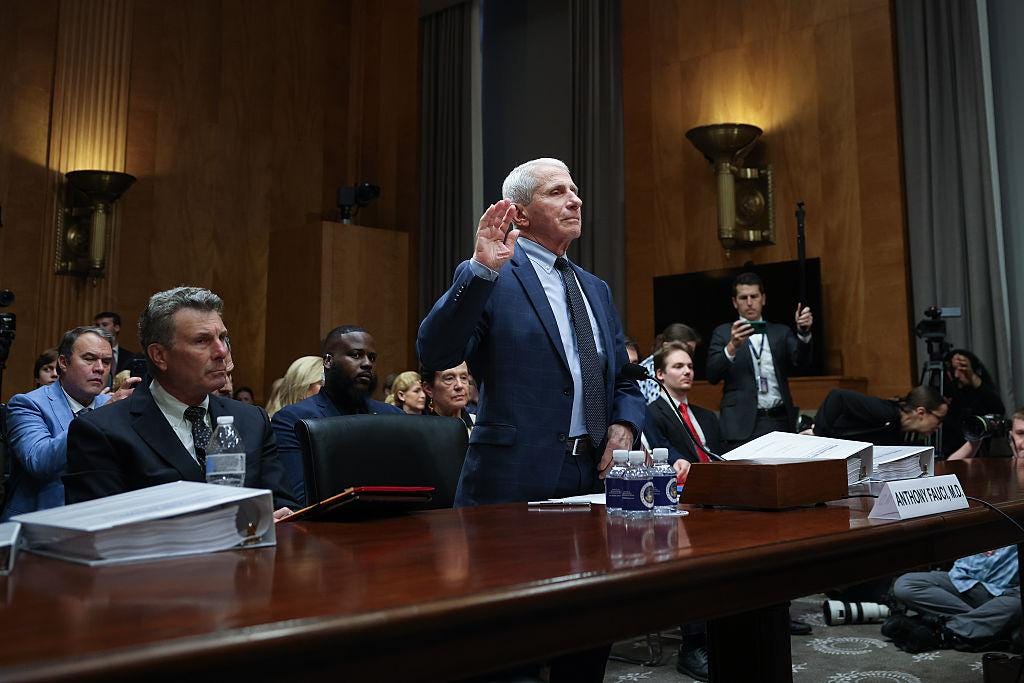
Late last month, Anthony Fauci sat before a Senate committee and repeatedly declined to answer questions.
He would not discuss the origins of Covid-19. He would not answer questions about government-funded coronavirus research or about emails investigators said raised concerns over federal recordkeeping. Those refusals were not entirely surprising. Fauci had been called before a committee led by Senator Rand Paul of Kentucky, a longtime antagonist who had already sought his criminal prosecution.
Then came questions that seemed almost absurdly simple. What day was it? What color was Fauci’s tie? Was there a folder sitting in front of him?
Fauci invoked the Fifth Amendment again.
For anyone who remembered the spring of 2020, the scene was remarkable. Six years earlier, Fauci had been one of the most recognizable doctors in America, appearing beside the president during frightening White House briefings and explaining a virus scientists were still struggling to understand. Now he was sitting before Congress as Republicans accused him of deception and demanded prosecution. A week later, the Senate committee voted along party lines to advance a contempt resolution against him.
How did the country get from one moment to the other?
For nearly four decades before Covid, Fauci directed the National Institute of Allergy and Infectious Diseases, working on H.I.V./AIDS, influenza, Ebola, Zika, SARS and other infectious diseases. Presidents of both parties relied on him. His public identity was built not around culture-war politics, but around infectious disease and biomedical research.
When Covid arrived, that background gave Fauci substantial institutional credibility and made him a natural national spokesman. His agency helped develop and test the Moderna vaccine. He emphasized clinical trials and resisted pressure to embrace treatments simply because they were politically popular. Hydroxychloroquine, promoted enthusiastically by President Trump and others, later failed to show meaningful benefit for hospitalized Covid patients in randomized trials.
Fauci was also often an effective communicator. He could explain complicated biomedical concepts in plain language, and research examining his pandemic-era appearances found that clarity, precision and repetition were recurring features of his public communication. In an environment saturated with fear, political conflict and contradictory messages, that ability helped make him one of the country’s most prominent scientific voices.
That record helps explain why Fauci initially carried such authority. It also helps explain why the reversals that followed carried so much weight.
The first cracks in public trust appeared early. In March 2020, Fauci told Americans that healthy people did not generally need to walk around wearing masks. At the time, hospitals were desperately short of protective equipment, scientists were still learning how easily people without symptoms could spread the virus and officials feared that public demand would worsen shortages.
Within weeks, the advice changed. The Centers for Disease Control and Prevention began recommending public masking as evidence accumulated that people who did not feel sick could nevertheless transmit the virus. To scientists, changing a recommendation as evidence changes is normal. That is how science is supposed to work. To many ordinary Americans, however, it looked much simpler: First the experts said masks were unnecessary. Then they said masks were important. If the second statement was true, people reasonably wondered why the first one had been made.
The changing guidance was difficult to communicate under any circumstances, and Fauci often explained complex science clearly. But officials, including Fauci, did not always make the underlying uncertainty, supply constraints and reasons for changing recommendations as explicit as they might have. A scientific question, whether masks reduced transmission, became entangled with a supply question, whether scarce masks should be preserved for hospital workers, and an uncertainty question, how much transmission was occurring from people without symptoms. The public often received a relatively simple answer when the reality was considerably messier.
That distinction matters. The problem was not that Fauci generally could not communicate. It was that some of the government’s most consequential messages were delivered in circumstances where scientific evidence, emergency logistics and policy judgments were changing at the same time. Even a skilled communicator could struggle to explain that combination without sounding inconsistent.
It was an early lesson in how quickly scientific uncertainty could become a question of personal credibility.
If masks weakened trust because the guidance changed, the six-foot distancing rule reinforced a different concern: rough judgments could sometimes be presented with the precision of settled science. Keeping people farther apart during the spread of a respiratory virus had a scientific rationale. But six feet sounded like a firmly established dividing line between danger and safety. Fauci later said he did not recall studies establishing that exact threshold, although public-health officials had drawn on earlier research about respiratory droplets and transmission. The problem was not that distancing lacked a basis. It was that the precision of the six-foot rule exceeded the strength of the evidence for that particular cutoff.
As the pandemic dragged on, Fauci’s recommendations were no longer being heard merely as medical advice. In the public debate, he had become closely associated with a larger system of restrictions affecting schools, businesses and ordinary life.
With schools, those questions became much more consequential because the costs of precaution were no longer abstract. Closing classrooms during the frightening first weeks of March 2020 was understandable. Officials did not know how severe the crisis would become, hospitals feared being overwhelmed and there were no vaccines.
But the calculation changed over time. Evidence increasingly showed that children generally faced much lower risks of severe disease than older adults. Schools learned to use ventilation, testing and other precautions. Meanwhile, the costs of keeping children away from classrooms became increasingly visible.
Pandemic-era learning losses were substantial. Absenteeism rose, and disadvantaged students often experienced particularly serious disruption. Remote schooling was not solely responsible. Illness, family stress, economic disruption and other effects of the pandemic also damaged learning. But research has linked prolonged virtual instruction with worse educational outcomes, making school closures an important part of the explanation.
Fauci did not order America’s schools closed. Governors, mayors, school boards, local health departments, unions and other institutions made those decisions. Yet he was the country’s most influential scientific voice, and his words mattered. It is fair to ask whether he and other public-health leaders gave enough weight to the accumulating costs of prolonged restrictions as evidence about risk changed.
The school debate captured a problem that would recur throughout the pandemic: the target kept moving. What was reasonable in March 2020 did not necessarily remain reasonable months later as scientists learned more about the virus, treatments improved and the costs of restrictions became clearer. The fair question is not simply whether guidance changed, but whether officials changed it quickly enough and explained why.
By then, Fauci had become a symbol as much as an adviser. To admirers, he represented expertise during a frightening emergency. To critics, he had become the human face of rules they believed had lasted too long or been presented with too much certainty.
Until that point, much of the case against Fauci concerned judgment. Wuhan changed the accusation. Critics were no longer asking only whether he had been wrong. They were asking whether he had been fully candid.
The National Institutes of Health gave money to EcoHealth Alliance, which in turn supported research involving bat coronaviruses at the Wuhan Institute of Virology. A federal inspector general later found that NIH and EcoHealth did not effectively monitor relevant awards and subawards and missed opportunities to oversee the research more effectively. That finding establishes a real oversight failure and gives Congress a legitimate reason to ask whether federal officials adequately supervised potentially risky research.
The controversy became more explosive because of the phrase “gain of function.” In broad scientific usage, the term can describe experiments that give an organism a new or enhanced characteristic. The federal government has also used narrower regulatory categories for particular kinds of potentially dangerous research.
Fauci and NIH relied on a narrower federal regulatory definition when denying that NIH had funded gain-of-function research in Wuhan, which is one reason the dispute has persisted. To an ordinary listener, however, Fauci’s categorical answer could easily sound broader: that the government had not supported research that enhanced viral characteristics at all. A fuller explanation of the definitional dispute would have been more transparent.
From there, suspicion grew beyond what the established evidence could bear. If federal money supported controversial coronavirus research in Wuhan, and if Fauci described that research too categorically, perhaps the research created SARS-CoV-2 and perhaps Fauci helped conceal it.
That conclusion has not been established. The origin of Covid remains unresolved. American intelligence agencies have differed over whether an animal spillover or a laboratory-related incident is more likely, with several assessments carrying low or moderate confidence. The C.I.A. shifted in 2025 toward viewing a laboratory origin as more likely, but did so with low confidence. Public evidence has not demonstrated that the particular NIH-funded research through EcoHealth created SARS-CoV-2.
Against that backdrop, 2020 messages disclosed by Senate investigators in which Fauci instructed recipients to delete an email after reading it took on unusual significance. In a political environment already shaped by allegations of concealment, the wording naturally invited questions. For a senior government official subject to record-retention requirements, those questions are legitimate.
But an email can be a reason to investigate without being proof of the larger theory. The messages do not, by themselves, establish that Fauci systematically destroyed required government records or concealed the origin of Covid.
To Fauci’s critics, the pieces increasingly seemed to fit together: changing guidance suggested unreliability, Wuhan raised questions about candor, and the deletion language appeared to offer evidence of concealment. But those pieces do not necessarily prove a common underlying theory. Each allegation still requires its own evidence.
All of those disputes eventually converged in the Senate hearing room where this story began.
Six years after Americans watched Fauci explain a new virus from the White House briefing room, he returned to Congress not as the government’s reassuring expert, but as a witness protecting himself from possible criminal exposure.
Senator Paul had spent years accusing Fauci of misleading Congress and had already asked the Justice Department to prosecute him. President Biden, shortly before leaving office, issued Fauci a broad pardon covering potential federal offenses arising from specified government service from Jan. 1, 2014, through Jan. 19, 2025.
The pardon removed substantial federal exposure for Fauci’s earlier government service, but legal experts noted that it did not necessarily eliminate every possible risk, including potential state prosecution or liability arising from later conduct. Fauci responded by invoking the Fifth Amendment again and again.
Invoking the Fifth Amendment is not evidence of guilt. The constitutional privilege exists to prevent a witness from being compelled to provide testimony that could be used in a criminal case. But Fauci’s use of it was exceptionally broad.
By refusing even apparently harmless questions, he made a legally arguable strategy look evasive. Americans watching clips of the hearing did not see the boundaries of a complicated constitutional argument. They saw a famous former government official refusing to say what color tie he was wearing.
The moment strengthened the very suspicions he was trying to protect himself from. It also highlighted the unusual setting: Fauci was being questioned by politicians who had already publicly argued that he should be prosecuted.
Congress has every right to investigate the pandemic response. It should examine poorly supervised research. It should determine whether federal records were preserved. It should ask whether officials testified accurately. The country spent trillions of dollars, endured extraordinary restrictions and lost more than a million people. Serious oversight is not optional.
Oversight and politics, however, can coexist. Paul may sincerely believe Fauci committed wrongdoing. The available evidence does not allow anyone to know his private motive with certainty. At the same time, Fauci is an intensely polarizing figure, particularly among Republican voters, and pursuing him carries obvious political value. Paul had reached severe conclusions about Fauci before the latest testimony. The committee’s contempt action divided along party lines. President Trump later suggested that Fauci should be prosecuted.
None of that makes the investigation illegitimate. It establishes that legitimate oversight is occurring inside a highly partisan environment in which punitive and political incentives are also present.
By the end of the hearing, the various controversies had been assembled into a much more serious claim. Masks, school closures, research grants, emails and testimony were no longer being cited merely as examples of mistakes. Together, they were being used to support an allegation about motive: that Fauci had not simply gotten things wrong, but had knowingly misled the public or concealed wrongdoing.
That is a much harder claim to prove.
The record shows a man who spent decades working against infectious disease, supported vaccines and clinical trials, made recommendations that were later revised and often communicated difficult scientific concepts effectively under extraordinary conditions. It also shows moments when uncertainty, policy tradeoffs and changing evidence were not communicated as clearly as they could have been. It shows an agency operating within a grant system that failed in important ways to oversee some coronavirus research. It shows statements about gain-of-function research that relied on a narrower federal definition but could reasonably have been understood more broadly by the public. It shows emails that warrant investigation. And it shows a former public official who, facing politicians already calling for his prosecution, chose an extraordinarily broad Fifth Amendment strategy that made him appear more evasive.
What it does not show is convincing evidence that Fauci wanted Americans harmed.
The problem is that much of this record is now being viewed through six years of hindsight. Accumulated knowledge can make the uncertainty of early 2020 difficult to remember. We now know far more about transmission, children’s risks, vaccines, treatments and the consequences of prolonged restrictions than officials knew when the first decisions were being made. Some policies remained in place after the evidence supporting them had weakened, and those choices deserve criticism. But officials should still be judged against what could reasonably have been known at the time, and against how readily they changed course when better evidence arrived.
Once hindsight is accounted for, the strongest criticism of Fauci is also the narrower one. He sometimes conveyed uncertain judgments with too much confidence, defended some positions too categorically and led an agency within a system that failed to oversee important research adequately. That is a serious record to examine. It is not the same as saying he was generally a poor communicator, and it is not evidence that he intended to harm the public.
The available record is much more consistent with a public-health official trying to reduce illness and death, sometimes getting the judgment wrong and sometimes failing to make uncertainty or changing assumptions explicit enough, than with a deliberate effort to harm Americans. That conclusion is necessarily an inference about intent, but it fits Fauci’s decades-long career, his stated objectives, the recommendations he consistently favored and the absence of persuasive evidence that he sought harmful outcomes.
Good intentions do not erase learning losses, weak research oversight or communication mistakes. Nor do they prevent Congress from demanding answers. But the same evidentiary discipline should govern the investigation itself. Legitimate oversight can coexist with political incentives, and investigators should distinguish mistakes from misconduct, misconduct from crime and suspicion from proof.
The Fauci sitting before Congress in 2026 was neither the infallible scientist some Americans imagined in 2020 nor the malevolent figure his harshest critics now describe. The evidence points to something more familiar: a public-health official trying to navigate a moving crisis, often communicating difficult science effectively, sometimes getting the judgment wrong and sometimes expressing more certainty than the evidence ultimately justified.
National disasters invite simpler narratives. In one, Fauci was “the science,” a heroic expert whose critics simply refused to listen. In another, he was the architect of lockdowns, mandates, school closures and perhaps even a cover-up surrounding the creation of Covid itself. Neither version survives close examination.
A better reckoning would be specific. If Fauci or his agency failed to supervise research properly, Congress should establish how and why. If he testified inaccurately, investigators should identify the statement and demonstrate what made it false. If government records were destroyed improperly, the evidence should establish what was deleted, who deleted it and whether the law was violated.
The strongest evidence supports a case against Fauci’s infallibility far more than it supports a case for villainy. He appears to have been trying to help, and he also made mistakes worth understanding. A serious reckoning with the pandemic has to be able to say both.
Evidence & Source Transparency
Evidence First shows its work. The article ends above; this section is included so readers can inspect the main sources behind the factual claims.
The list below does not source every sentence. It focuses on the factual claims most important to the argument.
1. Fauci’s pandemic role and the Moderna vaccine
Claim or topic:
Fauci led NIAID for nearly four decades, became a central figure in the federal Covid response, and NIAID participated in developing and testing the Moderna vaccine.
Source:
National Institutes of Health
Source type:
Government research agency and peer-reviewed clinical-trial summary.
What it supports:
NIH reported that the NIAID-supported Phase 3 trial found the original Moderna vaccine 94.1 percent effective at preventing symptomatic Covid-19 under the trial conditions.
Important caveat:
This figure describes the original trial before later variants emerged. Vaccine effectiveness changed as the virus evolved and immunity waned.
2. Fauci’s early mask guidance
Claim or topic:
In March 2020, Fauci told the public that healthy people generally did not need to wear masks, while also expressing concern about preserving protective equipment for healthcare workers. Public guidance changed as knowledge about transmission developed.
Source:
CBS News, March 8, 2020 interview
Source type:
Contemporaneous reputable journalism and recorded interview.
What it supports:
The interview documents what Fauci actually said at the time and provides context for the later controversy over changing mask recommendations.
Important caveat:
The interview establishes Fauci’s statements, not whether every aspect of the early mask policy was scientifically justified. Evidence and understanding of asymptomatic transmission were developing rapidly.
3. School disruption and learning loss
Claim or topic:
Students experienced substantial educational disruption during the pandemic, with virtual instruction presenting significant difficulties, particularly for some vulnerable students.
Source:
U.S. Government Accountability Office and GAO report on pandemic learning strategies
Source type:
Government research and nationally generalizable teacher survey.
What it supports:
GAO found that many teachers reported more students beginning the 2020-21 school year behind and making less academic progress than during a typical year. GAO also documented significant challenges associated with virtual learning.
Important caveat:
Learning loss cannot be attributed entirely to school closures or remote instruction. Illness, family disruption, economic stress and other pandemic effects also contributed.
4. NIH, EcoHealth Alliance and Wuhan research oversight
Claim or topic:
NIH funded EcoHealth Alliance, which provided subaward funding for coronavirus research at the Wuhan Institute of Virology, and federal auditors later identified significant weaknesses in oversight.
Source:
HHS Office of Inspector General
Source type:
Primary government audit.
What it supports:
The inspector general concluded that NIH and EcoHealth did not effectively monitor relevant awards and subawards, resulting in missed opportunities to oversee research. The audit included EcoHealth subawards to the Wuhan Institute of Virology.
Important caveat:
An oversight failure does not establish that the funded research created SARS-CoV-2 or caused the pandemic. Those are separate claims requiring separate evidence.
5. Covid’s origins remain unresolved
Claim or topic:
U.S. intelligence agencies have differed over the most likely origin of Covid-19. In 2025, the C.I.A. assessed a laboratory-related origin as more likely, but with low confidence.
Source:
Reuters
Source type:
Reputable journalism reporting an intelligence assessment.
What it supports:
Reuters reported that the C.I.A. shifted toward a laboratory origin as the more likely explanation while emphasizing that the agency had low confidence in that conclusion.
Important caveat:
“Low confidence” means the evidence is limited or uncertain. A possible laboratory origin also does not establish that NIH-funded EcoHealth research produced the pandemic virus.
6. Fauci’s deletion-language emails
Claim or topic:
Senate investigators disclosed pandemic-era messages in which Fauci instructed recipients to delete an email after reading it, raising legitimate questions about federal recordkeeping.
Source:
U.S. Senate Homeland Security and Governmental Affairs Committee
Source type:
Primary congressional document.
What it supports:
The committee document reproduces and discusses the deletion language that became part of the congressional investigation into Fauci’s communications and recordkeeping.
Important caveat:
The messages justify investigation but do not, by themselves, prove systematic destruction of required federal records, criminal conduct or concealment of Covid’s origin.
7. Fauci’s 2026 Senate testimony and Fifth Amendment invocation
Claim or topic:
At a July 29, 2026 Senate hearing chaired by Rand Paul, Fauci invoked the Fifth Amendment more than 100 times while being questioned about the pandemic response and related controversies.
Source:
Reuters and Reuters legal analysis
Source type:
Reputable journalism and legal analysis.
What it supports:
Reuters documented the hearing, Fauci’s repeated Fifth Amendment invocations, Paul’s previous efforts to seek his prosecution and the unresolved legal questions surrounding Fauci’s refusal to testify.
Important caveat:
Invoking the Fifth Amendment is a constitutional protection and is not evidence of guilt. The legal consequences of Fauci’s invocation remain disputed.
8. Biden’s pardon and the subsequent contempt dispute
Claim or topic:
President Biden pardoned Fauci for potential federal offenses arising from specified government service between Jan. 1, 2014, and Jan. 19, 2025. In August 2026, the Senate committee voted along party lines to hold Fauci in contempt, and Paul sought a Justice Department prosecution.
Source:
Text of President Biden’s pardon and Reuters on the 2026 contempt vote
Source type:
Primary presidential document and reputable journalism.
What it supports:
The pardon establishes its precise scope and dates. Reuters documents the later party-line committee vote, Paul’s referral to the Justice Department and the political and legal dispute surrounding Fauci’s testimony.
Important caveat:
The pardon does not establish that Fauci committed a crime. Nor does the contempt action establish the underlying allegations against him. Questions also remain about the legal force and procedure of the Senate referral.
How to read this evidence
This article is the author’s analysis. The sources above are provided so readers can see where the factual claims come from and judge the evidence for themselves. Some sources support direct facts, while others provide context, estimates, or background evidence.
Corrections and updates
If a factual error is identified, this post will be corrected in the web version with a dated note explaining the change. Because email versions cannot be edited after sending, the web version should be treated as the current version.