


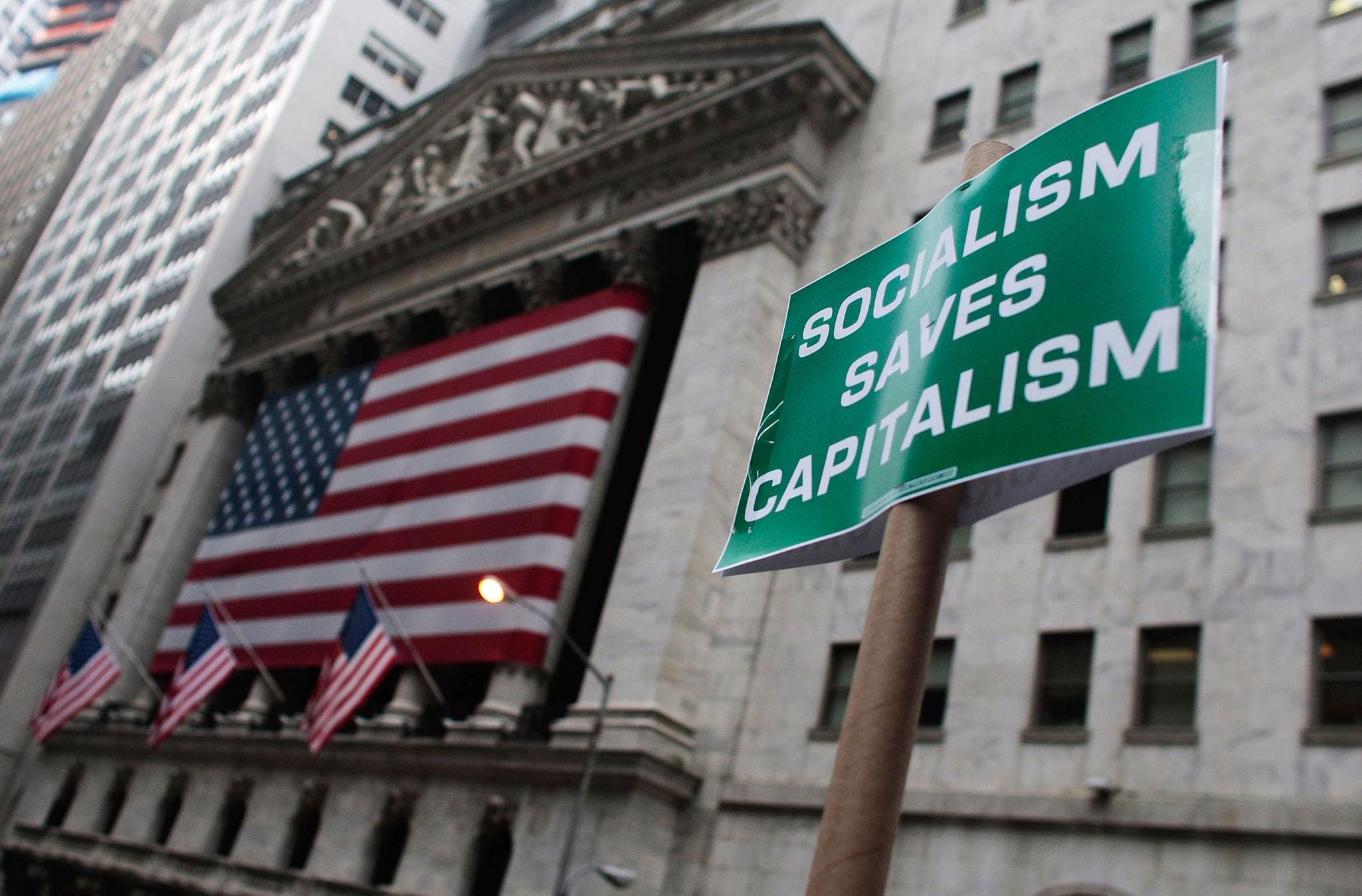
Something strange is happening in American politics. In a recent Psyclone study, half of self-identified Democrats said they would be open to the United States being governed under socialism. Only 44 percent said the same about capitalism. More surprisingly, 25 percent said they would be open to communism.
At first glance, those numbers seem to tell a simple story. Democrats are moving away from capitalism, toward socialism and, at the margins, toward ideas once considered far outside the American mainstream. But then consider a different set of numbers. Gallup found in 2025 that only 54 percent of Americans had a positive view of capitalism. Yet 81 percent viewed free enterprise positively, and 95 percent viewed small business positively.
Americans, in other words, appear to be cooling toward capitalism while remaining overwhelmingly fond of some of the institutions most closely associated with a market economy. How can both things be true?
That turns out to be the more interesting question. The evidence points to two developments happening at once. There has been a real change in political attitudes, especially among Democrats. But there is also growing disagreement over what words like capitalism, socialism and even communism are supposed to mean.
The change in attitudes is difficult to dismiss. Gallup found in 2025 that 66 percent of Democrats viewed socialism positively, compared with 42 percent who viewed capitalism positively. Republicans showed the opposite pattern, and much more sharply: 74 percent viewed capitalism positively and only 14 percent socialism. Pew Research Center found a similar partisan divide in 2022, with 57 percent of Democrats and Democratic-leaning independents positive toward socialism and 46 percent positive toward capitalism. A Fox News poll in 2026 again found socialism ahead among Democrats, 52 percent to 41 percent.
The exact percentages vary. A 2026 Cato Institute and Morning Consult survey, for example, found Democrats almost evenly divided, with 50 percent favorable toward socialism and 52 percent toward capitalism. But the broader pattern has appeared often enough, across different pollsters and different years, that it is difficult to explain away as statistical noise. Socialism has become at least as acceptable as capitalism among a large share of Democratic voters, while Republicans remain much more firmly attached to capitalism.
Before deciding what that shift means, however, we have to know what voters believe they are accepting and rejecting.
Ask two Americans what capitalism means and you may hear descriptions of entirely different societies. One person might picture a family opening a restaurant, an engineer building a company or a consumer choosing among competing products. Another might picture a pharmaceutical monopoly, unaffordable housing, billionaires wielding political influence or a family financially devastated by a medical emergency.
Socialism has the same problem. To one voter, the word conjures Soviet central planning, state ownership and bread lines. To another, it means Denmark, universal health insurance or simply making sure people can afford food, housing and medical care. Those are not minor differences in emphasis. They describe substantially different economic arrangements.
Pew encountered this directly when it asked Americans to explain their views in their own words. People who liked socialism often talked about fairness, social programs and meeting basic needs. Critics talked about government control, weak incentives and countries such as Venezuela. Some respondents explicitly said they preferred a mixture of capitalism and socialism rather than either system in pure form.
Gallup’s findings make the language problem even clearer. If Americans were broadly rejecting the institutions of a market economy, we might expect attitudes toward free enterprise and small business to decline along with attitudes toward capitalism. They have not. The gap between 54 percent positive toward capitalism and 81 percent positive toward free enterprise suggests that many Americans may be reacting less to markets themselves than to what the word capitalism has come to symbolize for them: corporate power, concentrated wealth, inequality or economic insecurity.
That might seem to solve the mystery. Perhaps socialism’s rise is mostly a matter of branding. Perhaps voters still want a market economy but increasingly dislike calling it capitalism.
The evidence is not quite that simple.
The Psyclone study offers a useful test because respondents were given short descriptions rather than being left entirely to their own understanding of the labels. Socialism was described as “shared ownership of major resources, aiming to reduce inequality while keeping some private property.” Communism was described as “state ownership of resources, aiming for a classless society.”
Under those definitions, 50 percent of Democrats said they would be open to socialism and 25 percent said they would be open to communism. Among Republicans, 29 percent were open to socialism and 20 percent to communism, while 53 percent were open to capitalism.
Those findings require care. Being “open to” something is not the same as preferring it, supporting it or wanting it implemented. The Democratic subgroup included 229 respondents, so the result should not be treated as a perfectly precise estimate of every Democrat nationwide. And the five-point Democratic-Republican gap on communism is too small, given the sample sizes, to establish a meaningful partisan difference with confidence.
Even with those qualifications, the result is revealing. Respondents were not simply saying they liked Medicare or thought Scandinavian countries seemed appealing. They were being asked to consider shared ownership of major economic resources, and half of the Democrats in the sample remained open to it.
That suggests two things are happening at the same time. Some Americans are plainly using socialism as a loose synonym for a generous welfare state. But some also appear receptive to more substantial changes in who owns and controls parts of the economy.
Survey respondents can hold vague or inconsistent ideas. Political organizations eventually have to put their goals into words. That makes the Democratic Socialists of America a useful real-world test of where ordinary welfare-state liberalism ends and something more radical begins.
The DSA’s current program goes considerably further than the social programs many Americans appear to associate with socialism. The organization asks supporters to imagine “a future without capitalism.” It describes a “classless society” as its “guiding star” and advocates public ownership of major corporations and essential industries.
Those are not simply proposals for a larger child tax credit, stronger labor protections or cheaper prescription drugs. They represent a fundamentally different view of who should own and control substantial parts of the economy.
That helps explain why Bill Maher’s recent argument that communist ideas exist inside DSA has a factual foundation. Explicitly communist and Marxist tendencies have existed within the organization, and parts of DSA’s stated program overlap with longstanding socialist and communist goals, including ending capitalism, expanding social ownership and ultimately eliminating class divisions.
But calling DSA simply communist leaves out something important. The organization also advocates multiparty democracy, proportional representation and competitive elections. Traditional authoritarian communist regimes did not merely socialize property. They concentrated political power in one-party states. DSA’s stated political vision retains electoral democracy.
The better conclusion is narrower. DSA is substantially more radical than ordinary welfare-state liberalism, and its program includes goals historically associated with Marxist socialism. At the same time, its stated political system is not Soviet-style one-party rule.
That distinction exposes a larger weakness in the entire capitalism-versus-socialism debate. If socialism can refer both to Medicare and to abolishing capitalism, the label eventually stops telling us enough. A more useful question is not which ideological word sounds better. It is which institutions work best for which purposes.
Markets have formidable strengths. Imagine that a city suddenly develops a taste for avocados. No government planner has to survey every household, calculate how many avocados people will want and issue production orders to farmers. Prices convey information. If demand rises, growers and distributors have an incentive to supply more. Stores experiment with what customers will pay, while competitors search for cheaper ways to grow, transport and sell the product.
The same process creates incentives to innovate. If someone develops a cheaper battery, opens a better restaurant or finds a faster way to deliver packages, a market economy gives that person a reason to try and gives competitors a reason to respond. Businesses can fail, investments can go wrong and technological change can destroy old jobs. But competition, private ownership and the possibility of profit can be powerful engines of innovation, adaptation and productivity.
That helps explain why Americans can dislike the word capitalism while remaining enthusiastic about entrepreneurship, free enterprise and small business.
Markets, however, have well-known weaknesses. Consider a factory that earns millions of dollars while polluting a river. The company receives the profit while families downstream bear part of the cost. Economists call this an externality, meaning that some costs created by a transaction fall on people who were not part of it. The market price may not reflect those costs.
Competition also works poorly when there is little actual competition. A monopoly can gain unusual power over prices, suppliers, workers and potential rivals. Health care presents another difficulty because a person having a heart attack is not in an ideal position to comparison-shop among hospitals, and patients usually know far less about medical treatment than the people providing it. Catastrophic illness, disability, unemployment and old age also create risks that individuals cannot always manage efficiently on their own.
Once those weaknesses are visible, the case for some collective action becomes easier to understand. Social insurance can spread risk. Public education can broaden opportunity. Environmental rules can make companies account for costs they would otherwise impose on others. Antitrust policy can preserve competition. Governments can build infrastructure and support basic scientific research whose benefits may be too widely dispersed for private companies to capture fully.
Many of these ideas have roots in socialism, social democracy or progressive reform, but adopting them does not require abolishing markets. In practice, most wealthy democracies have settled on something less ideologically pure. They combine private companies, markets, entrepreneurs and profits with public schools, pensions, regulation, unemployment insurance, infrastructure and publicly financed or subsidized health care. Across countries in the Organization for Economic Cooperation and Development, public social spending averages roughly one-fifth of economic output.
These countries are generally described as mixed economies. The basic bargain is straightforward, even if the details produce endless political fights: let markets handle the tasks they tend to perform well, use government where there are strong reasons to believe markets will produce poor outcomes, and place constraints on both private and public power.
Government, after all, has characteristic failures of its own. A regulation intended to protect consumers can end up protecting established companies from competition. Subsidies can become political favors. Bureaucracies can waste money. Poorly designed taxes can weaken useful incentives. The choice is therefore not between virtuous markets and dangerous government, or virtuous government and dangerous markets. It is about deciding which institution is better suited to which problem, and how to limit the ways each can go wrong.
Seen that way, the strange polling begins to make more sense. A Democrat can dislike “capitalism” while still supporting entrepreneurship and markets. A Republican can dislike “socialism” while strongly defending Social Security and Medicare. A voter can simultaneously believe in private property, environmental regulation, profitable companies, a safety net, competition and antitrust enforcement. The ideological labels imply a clean binary that the institutions themselves do not.
This brings us back to the contradiction at the beginning. How can capitalism draw relatively lukewarm support while free enterprise and small business remain overwhelmingly popular? One plausible answer is that many voters are not rejecting markets themselves. They are rejecting what they think capitalism has come to represent.
And how can socialism become more popular at the same time? Part of the answer is that many voters appear to associate socialism with social insurance, public services and protection against economic insecurity. But the Psyclone findings suggest that this is not the entire story. Some Democrats really do appear open to greater shared ownership, while organizations such as DSA show that an organized constituency for a genuinely post-capitalist economy exists.
The polling therefore points to two developments at once: a real ideological shift and a vocabulary problem. It would be a mistake to assume that every Democrat who likes socialism wants government ownership of major industries. It would also be a mistake to assume that every expression of support for socialism simply means that someone likes Medicare.
The more useful political questions lie underneath the labels. How much should markets decide? Where should government intervene? How much inequality should a society accept? When does social protection become excessive control? When does private economic power become large enough to require restraint?
Those questions are harder than asking Americans whether they approve of capitalism or socialism, but they are much closer to the argument the country is actually having. Many Americans appear to want entrepreneurship without monopoly, private property with a safety net, competitive markets with rules, and prosperity without financial catastrophe for people who become sick, disabled, old or simply unlucky.
That is neither laissez-faire capitalism nor comprehensive socialism. It is the mixed economy that most advanced democracies already practice.
The argument is over where to draw the lines.
Americans may agree much more about the ingredients than they do about what to call the recipe.
Evidence & Source Transparency
Evidence First shows its work. The article ends above; this section is included so readers can inspect the main sources behind the factual claims.
The list below does not source every sentence. It focuses on the factual claims most important to the argument.
1. Psyclone survey results
Claim or topic:
In the Psyclone study, 50 percent of self-identified Democrats said they would be open to socialism as defined in the survey, 44 percent to capitalism, and 25 percent to communism. Republican openness was 29 percent for socialism, 53 percent for capitalism, and 20 percent for communism.
Source:
Psyclone study results and party crosstabs supplied by the author.
Source type:
Primary research / original survey data.
What it supports:
These results provide the article’s central original comparison and allow attitudes toward defined economic systems to be examined by party.
Important caveat:
“Open to” does not mean “prefer” or “want implemented.” The Democratic subgroup contained 229 respondents, and the five-point Democratic-Republican difference on communism is too small to establish a clear partisan difference with confidence.
2. Gallup on capitalism, socialism and free enterprise
Claim or topic:
Democrats have become substantially more positive toward socialism than capitalism, while Americans remain much more positive toward free enterprise and small business than toward the word “capitalism.”
Source:
Gallup, “Image of Capitalism Slips to Record Low in U.S.”
Source type:
Expert organization.
What it supports:
Gallup reported 66 percent positive views of socialism and 42 percent positive views of capitalism among Democrats in 2025. Among Republicans, capitalism led socialism 74 percent to 14 percent. Nationally, 81 percent viewed free enterprise positively and 95 percent viewed small business positively.
Important caveat:
Favorability toward a label does not necessarily reveal which specific policies or ownership arrangements a respondent supports.
3. The broader partisan polling pattern
Claim or topic:
The Democratic shift toward greater acceptance of socialism is not unique to one pollster, although the size of the gap varies substantially.
Source:
Pew Research Center, 2022; Fox News, 2026; Cato Institute/Morning Consult, 2026 crosstabs
Source type:
Expert organization, reputable journalism, and primary document.
What it supports:
Pew and Fox found socialism rated more positively than capitalism among Democrats, while the Cato/Morning Consult survey found Democrats approximately tied between the two. Republicans remained more favorable toward capitalism.
Important caveat:
Different surveys use different samples, wording, question order and measures such as “positive,” “favorable” or “open to.” The percentages should not be treated as interchangeable.
4. What Americans mean by “socialism” and “capitalism”
Claim or topic:
Americans attach very different meanings to the same ideological labels, with some associating socialism with social programs and basic needs and others associating it with government control or failed authoritarian systems.
Source:
Pew Research Center, “In Their Own Words: Behind Americans’ Views of ‘Socialism’ and ‘Capitalism’”
Source type:
Expert organization.
What it supports:
Pew’s open-ended research shows that respondents use “socialism” and “capitalism” to describe a wide range of ideas. Some explicitly favored a combination of the two rather than either system in pure form.
Important caveat:
Open-ended responses reveal how people understand the terms, but they do not by themselves establish which economic arrangements produce better outcomes.
5. What the Democratic Socialists of America officially advocates
Claim or topic:
DSA’s stated program goes beyond ordinary welfare-state liberalism by calling for a future without capitalism, greater public ownership and a classless society, while also supporting multiparty electoral democracy.
Source:
Democratic Socialists of America, official program
Source type:
Primary document.
What it supports:
The source allows readers to examine DSA’s stated goals directly rather than relying on descriptions by supporters or critics.
Important caveat:
Overlap with historical socialist or communist goals does not by itself make DSA equivalent to Soviet-style one-party communism. Its official program also includes democratic political institutions.
6. Communist and Marxist tendencies within DSA
Claim or topic:
Explicitly communist and Marxist tendencies have existed within the broader DSA coalition.
Source:
Young Democratic Socialists of America, “Monday Hot Take”
Source type:
Primary document.
What it supports:
A publication from DSA’s youth organization described the movement as including communists alongside other ideological tendencies, supporting the narrower claim that communist currents exist within the organization.
Important caveat:
This does not establish what percentage of DSA members identify as communist or how influential those factions are across the organization as a whole.
7. Why markets and regulation can both have economic value
Claim or topic:
Competitive markets can support innovation and productivity, while regulation can improve outcomes when markets suffer from problems such as monopoly power, externalities or information failures.
Source:
OECD, “Time for a Regulatory Reset”
Source type:
Expert organization.
What it supports:
The OECD discusses both the economic value of competition and the legitimate role of well-designed regulation in addressing market failures.
Important caveat:
Recognizing a rationale for regulation does not determine how extensive a particular regulation should be. Poorly designed rules can themselves reduce competition or create economic costs.
8. Social protection inside modern market economies
Claim or topic:
Modern wealthy democracies commonly combine private markets with substantial public social spending rather than operating as either pure laissez-faire capitalist or comprehensively socialist systems.
Source:
OECD Social Expenditure Dashboard
Source type:
Expert organization.
What it supports:
OECD data show that public social expenditure is a major feature of advanced market economies, averaging roughly one-fifth of economic output across OECD countries.
Important caveat:
Countries differ substantially in taxation, public ownership, regulation and social spending. “Mixed economy” describes a broad family of arrangements rather than one single model.
How to read this evidence
This article is the author’s analysis. The sources above are provided so readers can see where the factual claims come from and judge the evidence for themselves. Some sources support direct facts, while others provide context, estimates, or background evidence.
Corrections and updates
If a factual error is identified, this post will be corrected in the web version with a dated note explaining the change. Because email versions cannot be edited after sending, the web version should be treated as the current version.