


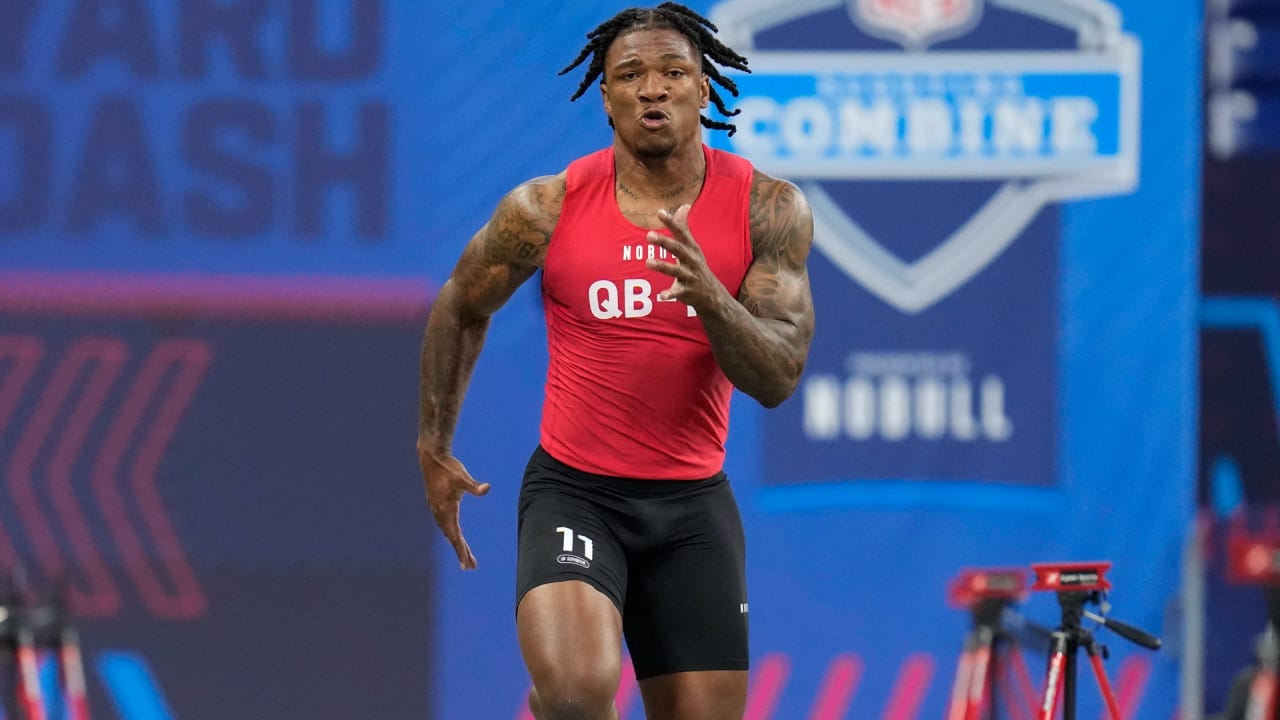
At the 2023 NFL scouting combine, Anthony Richardson seemed less like a quarterback prospect than a player assembled in a video game.
He weighed 244 pounds and ran 40 yards in 4.43 seconds, one of the fastest times recorded by a quarterback. He jumped 40½ inches vertically and nearly 11 feet horizontally. He could launch a football deep downfield with a flick of his arm and run through open space like a much smaller player.
He was also a one-year college starter who had completed just 54.7 percent of his passes.
That combination made Richardson one of the clearest examples of the question that hovers over nearly every quarterback draft: Should a team select the player with the rarest physical abilities and trust its coaches to teach him the rest?
The Indianapolis Colts answered yes, taking Richardson with the fourth pick. Evaluators knew the wager they were making. His accuracy and decision-making could fluctuate sharply, but his speed, size and throwing power were impossible to ignore. He was, in scouting language, a “high-ceiling, low-floor” prospect, someone capable of becoming a star but carrying an unusually high risk of falling short.
The idea behind such a selection is intuitively appealing. A coach can adjust a quarterback’s footwork, teach him a new offense and help him recognize defensive formations. A coach cannot make him six feet four inches tall or give him a stronger arm. Begin with the traits that cannot be manufactured, the reasoning goes, and develop everything else.
But quarterback is not merely a throwing position. It is a rapid-decision position whose most visible action, the pass, comes only after a sequence of less visible judgments.
Before the ball is snapped, a quarterback may need to identify which defenders are likely to rush, determine whether the defense is playing man-to-man or zone coverage and change the protection assigned to his offensive linemen. After the snap, the picture can change. Defenders disguise their intentions. Receivers alter their routes. The space available for a throw can open and disappear in a fraction of a second.
Arm strength determines whether a quarterback can reach that space. Quarterbacking ability determines whether he recognizes it in time.
What the Combine Can and Cannot Tell Us
Each winter, the NFL scouting combine turns athletic evaluation into television. Prospects sprint, jump, lift weights and weave around cones as teams collect exact measurements of their bodies and movement.
Those tests can reveal whether a player possesses the physical capacity required for his position. But research has repeatedly found that combine performance is much less useful for predicting what players will accomplish once games begin.
A study of quarterbacks, running backs and wide receivers drafted from 1999 through 2004 found no consistent relationship between combine results and professional performance, with the principal exception of sprint times for running backs. The researchers suggested that college performance might be more useful because it functions as a work sample: evidence of someone performing the actual job rather than completing a collection of standardized drills.
A later study examined 1,537 combine participants from 2013 through 2017. A model using three combine measures explained only about 2.6 percent of the differences in the players’ first-year professional performance. That does not make physical testing meaningless. It does suggest that a great workout should not be mistaken for a strong forecast.
The distinction is particularly important at quarterback. A 40-yard dash measures how quickly a player can run in a straight line under controlled conditions. It does not measure whether he will escape pressure while keeping his eyes downfield, recognize an uncovered receiver or decide that the safest choice is to throw the ball away.
A throwing exhibition can display velocity. It cannot reproduce the pressure of delivering the ball before a receiver appears open, knowing that a 270-pound defender is approaching from behind.
Physical ability, in other words, may expand the number of plays a quarterback is capable of making. It does not tell a team how often he will choose the right one.
The Josh Allen Problem
No contemporary quarterback has influenced this debate more than Josh Allen.
Before the Buffalo Bills selected him seventh in 2018, Allen was considered an enormous physical talent with equally substantial uncertainty. The NFL’s own draft analysis described him as perhaps the biggest boom-or-bust quarterback in the class. He had ideal size and arm strength, but a low college completion rate and recurring problems with anticipation and post-snap planning.
The analysis reached what turned out to be the decisive question: Could Allen improve the mental portions of his game, or would he remain another large, strong-armed quarterback who could make spectacular throws without becoming a dependable starter?
Allen improved. Dramatically.
He developed into one of the league’s leading quarterbacks and was named the Associated Press’s most valuable player for the 2024 season. The success of Buffalo’s wager demonstrated that a physically extraordinary but unpolished passer could make major technical and decision-making gains after entering the league.
It also created a trap.
Spectacular exceptions are easier to remember than ordinary failures. Once Allen succeeded, almost any large, mobile prospect with an inaccurate college record could be described as “the next Josh Allen.” His career became evidence that development was possible. It did not establish how probable such development was.
Richardson now represents the other side of the wager. Injuries repeatedly interrupted his early development, and his passing remained erratic when he was able to play. Across his first 17 appearances, including 15 starts, he completed 50.6 percent of his passes, with 11 passing touchdowns and 13 interceptions. Yet he also rushed for 634 yards and 10 touchdowns, evidence of the extraordinary physical ability that made him so attractive in the first place.
Richardson is still only 24 and has made just 15 NFL starts, so the verdict on his career is far from final. But entering 2026 as a candidate for the backup job shows how quickly a plan built around long-term development can lose momentum.
His results do not prove that his weaknesses were unfixable. They reveal another danger in drafting a quarterback who requires extensive development: A team may not receive the healthy practices, game repetitions and organizational stability needed to discover whether that development is possible.
Allen’s success showed that a physically exceptional quarterback could overcome serious concerns about accuracy and decision-making. Richardson’s experience shows why teams cannot assume that the same transformation will follow merely because the raw materials look similar.
Possibility is not probability. Even a sound development plan depends on circumstances a team cannot fully control.
One Team, Two Opposite Bets
The San Francisco 49ers offer an unusually vivid case study because they made two radically different quarterback investments in consecutive drafts.
In 2021, San Francisco traded the 12th pick, two additional future first-round selections and a third-round pick to move up to No. 3. The team used that selection on Trey Lance, a physically gifted quarterback from North Dakota State.
Lance had produced an exceptional 2019 season, passing for 28 touchdowns without an interception and adding 1,100 rushing yards. But he had played only one game in 2020 after the pandemic disrupted the college season. Evaluators questioned his accuracy, elongated throwing motion and limited experience against complex defenses.
The physical and theoretical appeal was clear. Lance was young, mobile and strong-armed. In the right system, with professional instruction, he seemed capable of becoming a modern dual-threat quarterback, one who could damage a defense both by passing and running.
The bet did not work in San Francisco. Injuries complicated Lance’s development, but he also failed to secure the job. In 2023, the 49ers traded him to Dallas for a fourth-round pick.
By then, his replacement had already arrived.
Brock Purdy was the final selection of the 2022 draft, the 262nd player chosen. He lacked Lance’s draft status and exceptional physical profile. He began his first training camp behind Lance and veteran Jimmy Garoppolo, with no guarantee that he would even remain on the roster.
After injuries moved him into the lineup, Purdy operated San Francisco’s offense well enough to become its starter and eventually helped take the team to Super Bowl LVIII.
The comparison does not prove that modestly gifted quarterbacks are better than great athletes. Purdy entered a well-designed offense surrounded by accomplished players, and no quarterback’s performance can be separated completely from his coaches, blockers and receivers.
But the episode reveals how much quarterback value can escape physical measurement. The 49ers spent their most valuable draft resources on the more impressive physical projection. They found the more successful operator, at least for their offense, with the final pick a year later.
Is Accuracy Teachable?
Coaches can plainly improve throwing mechanics. They can alter the width of a quarterback’s stance, shorten his release and coordinate his upper body with his feet. The harder question is whether those changes produce accurate passing when defenders are moving, protection is collapsing and the quarterback must make several decisions at once.
Some evidence suggests that college accuracy should not be dismissed as a temporary flaw.
Sports Info Solutions studied 22 quarterbacks who had accumulated at least 300 professional passing attempts within their first two or three NFL seasons. It used “on-target percentage,” a measure intended to capture whether a pass was delivered to the proper location rather than simply whether the receiver caught it.
College accuracy on short throws, passes traveling fewer than 11 yards, had a correlation of 0.73 with early professional accuracy at the same distance. In plain language, quarterbacks who consistently placed short passes well in college tended to do so in the NFL. The college measure accounted for about half the variation in early-career professional short accuracy in that small sample.
Accuracy on intermediate and deep passes transferred less reliably. Those throws are more difficult and more affected by protection, receiver separation and the quality of the defense. The study also found that professional accuracy on intermediate throws was more closely associated with overall quarterback performance than deep-ball accuracy was.
The sample was small, and correlation is not destiny. Allen substantially exceeded the prediction created by his college accuracy. Other quarterbacks did not.
Still, the findings challenge a common scouting habit: treating routine inaccuracy as an easily repairable mechanical inconvenience while becoming captivated by an occasional 60-yard pass. The spectacular throw may demonstrate a rare ceiling. The ordinary eight-yard pass may reveal more about what the quarterback will be asked to do repeatedly.
Baker Mayfield, for example, was the most accurate college passer at short, intermediate and deep distances among the quarterbacks in the Sports Info Solutions sample. That precision largely carried into his professional career, even though his aggressive style sometimes attracts more attention than his placement.
Measuring the Part Between the Ears
Because traditional physical tests leave so much unexplained, teams have increasingly looked for ways to measure the cognitive demands of quarterback play.
A 2025 study examined 42 quarterbacks who had completed a tablet-based cognitive assessment before entering the NFL. The test measured abilities including reaction time, decision-making and visual-spatial processing, the capacity to understand where objects are located and how they are moving in relation to one another.
Those concepts have obvious football equivalents. A quarterback must notice a defender moving toward the line, track several receivers crossing through the same area and decide where the ball should go before the available space disappears.
The researchers found that reaction time and certain combinations of decision-making and visual-spatial performance added predictive information beyond draft position for several professional outcomes. Quarterbacks who scored highly in both visual-spatial processing and decision-making had throwing-accuracy rates about six percentage points higher than quarterbacks with average scores on those measures.
The results are intriguing, but they are not a solution to quarterback evaluation. Forty-two players constitute a small sample. The study could not fully account for coaching, offensive scheme, offensive-line quality or the players surrounding each quarterback. Its authors also warned about possible sampling bias.
Most important, the study did not establish that these cognitive abilities could be substantially trained after a player was drafted.
That distinction is often lost. A characteristic can be important without being easily teachable. Improvement on a computer exercise also does not necessarily transfer to a football field, where the quarterback must combine perception, memory, movement and emotional control while facing physical danger.
The study’s authors noted that evidence for this kind of transfer from generalized cognitive training to actual sports performance has been underwhelming.
A Better Way to Think About Development
The familiar division between “innate” and “learned” traits is probably too simple.
Some characteristics are tightly constrained. A team cannot meaningfully change a quarterback’s height, limb length or natural top-end speed. Throwing power may improve at the margins, but an exceptionally strong arm is largely an advantage a player brings with him.
Other skills are more visibly teachable. Coaches can instruct footwork, explain defensive structures, install protection rules and help a quarterback understand when to abandon a play.
The most consequential qualities occupy the uncertain space between those categories. Accuracy, anticipation, pocket awareness, decision speed and judgment under pressure can improve. But they do not improve equally in every player, and teams have no dependable formula for predicting the size of that improvement.
The useful question, then, is not whether a prospect can get better. Almost every young quarterback can.
It is how much improvement he requires, what evidence shows that he has improved before, whether his flaws have a specific and correctable cause, and what the team must sacrifice to acquire him.
A quarterback whose feet become disorganized on certain throws presents a more precise developmental problem than one who repeatedly fails to see an uncovered defender. A player who has already corrected mistakes from one college season to the next offers stronger evidence of coachability than a player whose evaluators merely describe him as intelligent and hardworking.
The price matters, too. A team can reasonably take a chance on extraordinary but unfinished ability later in the draft or while an established starter remains in place. At the top of the first round, the cost is much greater. A failed selection can consume several seasons, cost coaches and executives their jobs and prevent a team from using its most valuable picks on other needs.
That is what made the Lance decision so consequential and the Purdy selection so valuable. The difference was not only performance. It was the amount San Francisco had risked to obtain each player.
The Evidence Behind the Bet
The available research does not support ignoring physical gifts. Arm strength can widen the field, mobility can rescue broken plays and size can help a quarterback withstand contact. A player without sufficient physical capacity may be unable to execute an offense, no matter how quickly he processes information.
But the evidence also does not support selecting the best athlete and assuming that professional coaching will supply the rest.
Combine tests have shown limited power to predict performance. College accuracy, particularly on shorter throws, appears to retain meaningful information. Early cognitive research suggests that reaction time and decision-making matter, while providing little assurance that they can be rapidly manufactured after draft day.
Josh Allen shows why teams continue to make the wager. Anthony Richardson shows why the outcome may remain uncertain even when the physical potential is unmistakable. Trey Lance shows why the gamble can be ruinously expensive. Brock Purdy shows how much value may be hidden in the less spectacular parts of the position.
The strongest drafting principle is therefore less dramatic than the search for the next physical marvel. Teams should first identify quarterbacks who already demonstrate a minimum professional foundation: the ability to place routine passes, recognize developing plays, make timely decisions and respond to mistakes. Exceptional arm strength and athleticism can then raise the ceiling among the players who clear that threshold.
The ideal prospect is not simply the most polished passer or the most impressive athlete. He is the player who has already shown that he can perform the essential work of quarterbacking, and whose physical gifts give him room to do still more.
The safest lesson is not to avoid raw talent. It is to stop treating talent as a substitute for evidence.
Evidence & Source Transparency
Evidence First shows its work. The article ends above; this section is included so readers can inspect the main sources behind the factual claims.
The list below does not source every sentence. It focuses on the factual claims most important to the argument.
1. Anthony Richardson’s pre-draft profile
Claim or topic:
Richardson entered the 2023 draft with exceptional size, speed and arm strength, but limited starting experience and significant accuracy concerns.
Source:
NFL.com’s 2023 quarterback evaluation
Source type:
Expert organization and scouting analysis.
What it supports:
The source documents the physical traits that made Richardson a top prospect, along with evaluators’ concerns about his experience, accuracy and readiness.
Important caveat:
Scouting evaluations contain professional judgment and projection. They are not controlled research and do not establish which weaknesses will improve.
2. What combine testing predicts
Claim or topic:
Standard combine tests have shown limited ability to predict later NFL performance.
Source:
2008 study indexed by PubMed and 2020 study indexed by PubMed
Source type:
Academic research.
What it supports:
The studies found little consistent association between combine performance and later production. In the larger study, a model based on three combine measures explained only about 2.6 percent of the differences in first-year performance.
Important caveat:
These studies examined multiple positions and selected combine drills. They do not capture every form of functional quarterback athleticism, such as throwing velocity while moving or escaping pressure.
3. Josh Allen as the successful development case
Claim or topic:
Allen entered the NFL as a physically exceptional but uncertain prospect, then developed into one of the league’s leading quarterbacks.
Source:
NFL.com’s 2018 Bills draft coverage and NFL.com’s report on Allen winning the 2024 AP MVP award
Source type:
Expert organization and reputable sports journalism.
What it supports:
The sources document the concerns surrounding Allen’s accuracy and anticipation before the draft, as well as the high level of performance he later reached.
Important caveat:
Allen proves that major development is possible. His individual success does not show how often quarterbacks with similar weaknesses will follow the same path.
4. Richardson’s early NFL results
Claim or topic:
Richardson’s early career has combined poor passing efficiency, substantial rushing production and limited playing time.
Source:
Anthony Richardson’s NFL statistics and Indianapolis Colts player profile
Source type:
Primary league data and expert organization.
What it supports:
The sources provide his appearances, starts, completion rate, passing touchdowns, interceptions, rushing yards and rushing touchdowns. They also provide basic biographical and roster information.
Important caveat:
Richardson’s sample is small and repeatedly interrupted by injuries. His statistics do not establish that he cannot improve or that his career outcome is settled.
5. Trey Lance and the cost of projection
Claim or topic:
San Francisco invested several premium draft picks in Lance, whose appeal rested partly on physical ability and developmental potential, before trading him for a fourth-round pick.
Source:
NFL.com’s 2021 quarterback evaluation and the 49ers’ official Lance trade announcement
Source type:
Expert organization and primary team announcement.
What it supports:
The sources document Lance’s strengths, limited college experience and developmental concerns, as well as the eventual trade to Dallas.
Important caveat:
Injuries substantially affected Lance’s opportunity to develop. His outcome cannot be attributed solely to poor scouting or an inability to learn the position.
6. Brock Purdy as the contrasting case
Claim or topic:
Purdy was selected with the final pick of the 2022 draft and later became San Francisco’s starter, helping the team reach Super Bowl LVIII.
Source:
NFL.com’s coverage of Purdy and the 49ers
Source type:
Reputable sports journalism.
What it supports:
The source documents Purdy’s draft position, rise from the bottom of the depth chart and success in San Francisco’s offense.
Important caveat:
Purdy’s performance cannot be separated from coaching, scheme, pass protection and the quality of his teammates. His success does not prove that less physically impressive prospects are generally better.
7. Whether college accuracy carries into the NFL
Claim or topic:
Short-pass accuracy in college may contain meaningful information about a quarterback’s early NFL accuracy.
Source:
Sports Info Solutions analysis of college and NFL on-target percentage
Source type:
Analysis by a sports-data organization.
What it supports:
The analysis found a strong association between college and early-career NFL accuracy on short throws. It also provides the article’s comparison involving Josh Allen and its example involving Baker Mayfield.
Important caveat:
The sample included only 22 quarterbacks. The results are suggestive, not definitive, and do not prove that accuracy is fixed or unteachable.
8. Cognitive testing and quarterback performance
Claim or topic:
Reaction time, decision-making and visual-spatial processing may add predictive information beyond draft position.
Source:
2025 study in Frontiers in Psychology
Source type:
Peer-reviewed academic research.
What it supports:
The study found associations between certain cognitive-test results and several measures of later quarterback performance, including throwing accuracy.
Important caveat:
The study included 42 quarterbacks and could not fully account for coaching, scheme, offensive-line play or surrounding talent. It also did not show that improving performance on generalized cognitive tests produces better quarterback play.
How to read this evidence
This article is the author’s analysis. The sources above are provided so readers can see where the factual claims come from and judge the evidence for themselves. Some sources support direct facts, while others provide context, estimates, or background evidence.
Corrections and updates
If a factual error is identified, this post will be corrected in the web version with a dated note explaining the change. Because email versions cannot be edited after sending, the web version should be treated as the current version.