


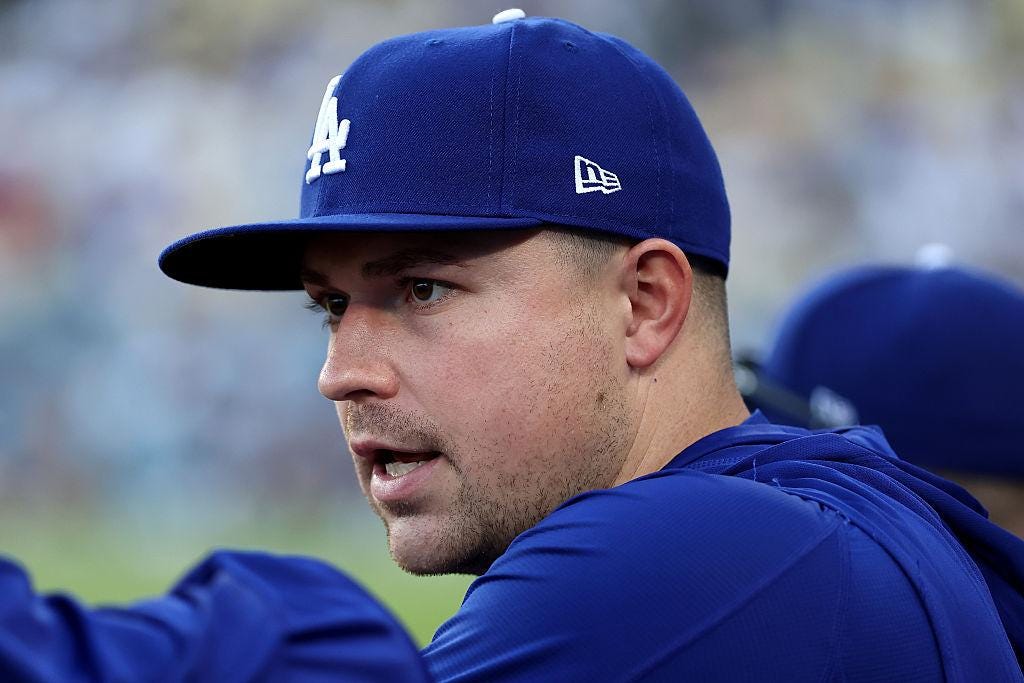
Tarik Skubal did not sound like a man celebrating a promotion.
After the Detroit Tigers traded him to the Los Angeles Dodgers on Aug. 2, the two-time defending American League Cy Young Award winner fought back tears as he described leaving the organization that had drafted and developed him. He had imagined winning a championship in Detroit. Instead, he joined the two-time defending World Series champions, who were leading their division by 10 games and already tied for the best record in baseball. The Tigers, meanwhile, were only 2½ games from an American League wild-card position.
The transaction appeared to capture everything critics say is wrong with Major League Baseball: A borderline contender surrendered its best player, while the sport’s wealthiest and most formidable organization added another ace to an already imposing roster.
It was, in the familiar phrase, a case of the rich getting richer.
But the Skubal trade also illustrates why baseball’s competitive-balance debate is harder than it first appears. The sport has enormous financial disparities, yet its games are unusually unpredictable. The Dodgers can outspend almost everyone, but money alone did not produce this trade. And although a salary cap might weaken their ability to assemble a roster this expensive, it would not necessarily stop a contender from exchanging prospects for a star whose contract is about to expire.
Baseball has a real problem. It is simply not one problem.
More Financially Unequal, but Not Necessarily Less Competitive
To understand the paradox, it helps to separate financial balance from competitive balance.
Financial balance concerns what teams can afford to spend. On that measure, baseball is plainly lopsided. Unlike the National Football League, National Basketball Association and National Hockey League, MLB has no system combining a leaguewide payroll ceiling with a meaningful minimum. It instead uses a competitive balance tax, commonly called the luxury tax, which makes high payrolls more expensive without prohibiting them.
The spending gap has grown. According to MLB’s own analysis, the average payroll of the five highest-spending teams in 2025 was 4.8 times the average of the five lowest, the widest ratio in the league’s data going back to at least 1985. That analysis comes from a league actively arguing for a salary cap, so its policy conclusions should not be treated as neutral. But the disparity itself is substantial.
In 2026, the Dodgers opened the season with a luxury-tax payroll of roughly $415 million. Miami’s was about $82 million. Los Angeles’s total was so far above the $245.3 million cap proposed by MLB that the club would have needed a lengthy transition to comply.
Yet payroll inequality is not the same thing as unequal game outcomes. A study examining the NBA, NFL, NHL and MLB from 1991 through 2018 attempted to account for the leagues’ radically different season lengths and scoring environments. It estimated that the better team in an average baseball matchup won only 56.6 percent of the time. The corresponding estimate was 59 percent in hockey and about 67 percent in both basketball and football.
In a theoretical matchup between the league’s best and worst teams, the top baseball club had an estimated 68.5 percent chance of winning. In the NBA and NFL, that figure was about 96 to 97 percent. The study concluded that MLB displayed the greatest balance in underlying game-level strength, followed by the NHL.
These are historical model estimates, not eternal laws. Competitive balance can also be measured by championship concentration, year-to-year turnover or the number of meaningful late-season games, and different measures can produce different rankings. Still, the central point is important: A weak baseball team has a fairly good chance of beating a great one on any particular night. Starting pitchers change daily. A few well-timed hits can decide a low-scoring game. Even the best hitter fails most of the time.
Baseball’s 162-game schedule gradually reveals differences in quality, but the sport itself contains a great deal of randomness. That helps explain how MLB can look financially alarming while remaining more competitive on the field than the NBA, where one superstar can influence nearly every possession.
That does not make the concern imaginary. Leaguewide parity can coexist with individual moments that reveal how financial and organizational advantages accumulate. The Skubal trade was one of those moments.
What the Skubal Trade Actually Shows
Skubal’s move to Los Angeles is best understood as an example of upward talent concentration: elite players migrating from uncertain or short-lived competitive situations toward organizations already positioned to win.
But it is not a pure example of a large-market team purchasing a player a small-market team could not afford. Skubal was under contract only through the end of the season. The Dodgers did not win a free-agent bidding war for a nine-year contract. They traded three young players, outfielder Zyhir Hope and pitchers River Ryan and Brady Smith, for two months of Skubal and whatever he might contribute in October.
That distinction matters because the immediate currency was not merely cash. It was organizational depth. The Dodgers could afford to surrender highly regarded young players without emptying their farm system. They could absorb Skubal’s remaining salary, tolerate the possibility that he would leave after the season and accept the injury risk inherent in any pitcher. They also had an unusually strong reason to prioritize the present: the chance to win a third consecutive championship.
Detroit faced the reverse calculation. Keeping Skubal offered a better chance of reaching the 2026 postseason, but it also risked losing him for comparatively limited compensation after the season. Under the current qualifying-offer system, a team that retains an eligible player approaching free agency and then loses him can receive a draft pick. But a concrete package of three prospects may be far more attractive than a single future selection.
Nothing in the available evidence proves that Detroit was literally incapable of extending Skubal. Financial inability, unwillingness to meet his expected price and a judgment that the prospects were more valuable are different explanations. The Tigers’ decision may have been rational.
That is precisely the concern. A system can produce troubling leaguewide results even when every individual decision makes sense.
The Dodgers should not be faulted for using the rules effectively. Skubal himself noted that other teams could have tried to acquire him, and several reportedly did. But theoretical access is not the same as equivalent capacity. Los Angeles combined money, a deep roster, a strong farm system, deferred contracts and a willingness to assume risk in a way few clubs could match. After adding Skubal, the Dodgers employed five of baseball’s 13 highest-paid starting pitchers and carried roughly $1.1 billion in deferred salary obligations.
The issue, then, is not simply that the Dodgers spend lavishly. It is that they can accumulate several forms of advantage at once: payroll, prospects, roster depth and the ability to accept risk. When one organization can combine those advantages on such a scale, a payroll ceiling can seem like the simplest answer.
The Temptation of a Salary Cap
MLB owners have proposed just such a system. Beginning in 2027, their plan would establish a $245.3 million payroll ceiling and a $171.2 million floor, using the league’s luxury-tax accounting. That accounting includes benefits and other costs beyond salaries paid directly to major-league players. MLB has also proposed centralizing local-media revenue, dividing it equally among the 30 clubs and allocating players 50 percent of defined baseball revenue.
A system like that would unquestionably compress payrolls. Based on opening-day figures, eight teams would have needed to cut spending, while 12 would have been required to add a combined $617 million. The Dodgers could not maintain their current roster indefinitely under such a ceiling.
But calling that a complete solution is too easy. A cap would constrain the Dodgers’ financial power over time, yet it would not directly prevent a team from trading prospects for an affordable player approaching free agency. In some circumstances, a cap could even make stars more likely to move if their original clubs lacked room for long-term extensions.
Nor does a cap guarantee competent ownership. Teams can mismanage equal budgets, keep shared revenue or spend a payroll floor inefficiently. Salary restrictions may improve payroll equality while also reducing the share of revenue paid to players. Those are separate questions, and a policy that helps owners control labor costs is not automatically a competitive-balance reform.
The players’ union has therefore proposed a different approach: greater revenue sharing, a higher minimum salary, earlier access to salary arbitration, expanded compensation for productive young players and a competitive integrity tax on clubs that fail to reach minimum payroll benchmarks. Salary arbitration is a process in which eligible players can argue that their performance justifies a higher salary. Most players do not qualify for it during their first few major-league seasons.
The union’s proposal would also penalize teams that receive revenue-sharing money but fail to use enough of it on payroll. MLB argues that the union’s plan would weaken restraints on the highest spenders, while the union argues that a cap would primarily increase owner profits. Both sides have obvious financial interests in how they describe the dispute.
The real choice, then, is not simply between a cap and no cap. It is between reforms that address only payrolls and those that address the wider system that moves money, prospects and stars toward the same clubs.
A More Targeted Fix
The most direct place to begin is local-media revenue.
At present, teams can earn very different amounts from the television and streaming rights to games shown in their home markets. Consider the Dodgers and Tigers. The Dodgers’ local-media agreement is valued at about $334 million per year on average, while the Tigers’ previous publicly reported television agreement paid about $50 million per year. The Dodgers number is the yearly average from a long contract, while the Tigers number comes from an older deal. The comparison is not exact, but it shows how much more one team can make from local TV than another. Before either club sells a ticket or makes a roster decision, one can begin with a local-media advantage worth hundreds of millions of dollars.
Under a more centralized system, MLB would collect a larger share of local television and streaming revenue and distribute much of it equally among all 30 clubs. The league might still allow teams to keep part of the revenue they generate, preserving an incentive to attract viewers and market the club. But the starting gap would be smaller.
That would not guarantee equal payrolls or equally successful teams. An owner could still spend poorly or refuse to invest. But it would reduce a structural disadvantage that has little to do with scouting, coaching or smart decision-making, and it would make it more plausible for lower-revenue clubs to retain star players.
Greater revenue sharing, however, would accomplish little if some owners simply kept the additional money. That is why MLB would also need a genuine payroll floor, preferably one tied automatically to league revenue. It should measure meaningful player spending, not allow teams to satisfy the requirement primarily through benefits or accounting devices. Revenue-sharing payments should also come with transparent requirements showing that clubs are investing in their major-league teams, player development and other competitive operations.
Even with more shared revenue and a payroll floor, Detroit might still have faced the same choice with Skubal: keep him for a few months or trade him before losing him. To change that calculation, MLB could give teams more value for retaining elite players approaching free agency. Stronger draft compensation for a lower-revenue club that keeps and then loses a star would make selling less irresistible. A centrally funded credit for extending homegrown players could also help teams keep the stars they developed without reducing the players’ salaries.
If better compensation would give Detroit more reason to keep Skubal, an earlier trade deadline would give the Dodgers fewer chances to acquire him. It would force borderline contenders to decide whether to sell before the standings fully clarify, reducing the supply of elite short-term acquisitions available to dominant clubs. The trade-off is that genuinely weak teams might receive smaller returns or lose opportunities to rebuild. But unlike a salary cap alone, an earlier deadline would address the mechanism that produced the Skubal trade.
Baseball could also pay productive young players more quickly. The current labor system keeps many of them near the minimum salary early in their careers and under team control for roughly six years. Better bonuses for players who have not yet reached salary arbitration, along with earlier access to arbitration, would better align compensation with performance. This would not directly prevent an elite rental from joining a contender, but it would make the broader system less dependent on years of inexpensive young labor followed by costly free agency.
Taken together, these reforms address three different weaknesses: unequal resources, weak incentives to retain stars and a trade system that can move elite players toward teams already built to win. No single rule would eliminate baseball’s financial disparities or prevent every star from joining an established contender. The goal is not to stop smart teams from improving. It is to make continued competition a more reasonable choice for everyone else.
None of these changes can happen without a new agreement between owners and players. That is why the debate over competitive balance is now inseparable from the threat of a lockout.
A Lockout Is Not a Reform
The current labor agreement expires Dec. 1, and MLB is expected to impose a lockout if no new deal is reached. A lockout is an action taken by owners. It freezes signings, trades and other league business in an effort to pressure players into accepting a new labor agreement. It is different from a strike, which is initiated by players.
The league’s previous lockout lasted 99 days and ended in March 2022 without canceling the 162-game regular season. The much longer 1994-95 dispute, which was a player strike, canceled the World Series and remains the sport’s enduring warning about labor warfare.
A lockout could give owners leverage to obtain a cap. It could give players leverage if they remain united and force concessions on revenue sharing, minimum salaries or early-career pay. It could end with a more balanced system. But the lockout itself would solve nothing. It is an economic weapon intended to change the bargaining position of the other side, and the same beneficial reforms could, in principle, be negotiated without losing games.
A brief lockout that ends with greater revenue sharing, a real payroll floor, higher compensation for young players and better incentives for teams to retain their stars could eventually improve the sport. A long lockout that produces only a salary cap could mainly reduce player compensation while leaving many of the forces behind talent concentration intact.
Whatever emerges from the negotiations should be judged by a simple test: Would it make a decision like Detroit’s less inevitable?
The lesson of the Skubal trade is not that baseball needs to stop ambitious teams from being ambitious. Well-run organizations should be rewarded. The problem arises when the system makes it consistently rational for a club near the playoff race to trade its best player, while allowing one organization to combine unmatched spending, prospect depth and risk tolerance indefinitely.
Baseball does not need every team to finish 81-81. It needs every well-run team to have a credible chance to keep the players it develops, and every owner to face a real obligation to try.
That outcome may require limits, revenue sharing and new incentives. It does not require pretending that a salary cap is a cure, or that a lockout is anything more than the painful route the sport may take to reach an agreement.
Evidence & Source Transparency
Evidence First shows its work. The article ends above; this section is included so readers can inspect the main sources behind the factual claims.
The list below does not source every sentence. It focuses on the factual claims most important to the argument.
1. The Tarik Skubal trade
Claim or topic:
Detroit traded Tarik Skubal to the Dodgers while the Tigers remained close to a wild-card position, and Skubal expressed disappointment about leaving.
Source:
Reuters
Source type:
Reputable journalism.
What it supports:
The report documents the trade, Detroit’s position in the standings, Skubal’s reaction and the immediate competitive context.
Important caveat:
The article uses the trade as an example of a broader structural issue. One transaction alone cannot establish a leaguewide pattern.
2. The players included in the trade
Claim or topic:
The Dodgers acquired Skubal by trading outfielder Zyhir Hope and pitchers River Ryan and Brady Smith.
Source:
MLB
Source type:
Expert organization and league reporting.
What it supports:
The source identifies the players exchanged and provides background on their prospect status and organizational value.
Important caveat:
Prospect rankings are estimates of future value, not guarantees of major-league success.
3. MLB’s payroll disparity
Claim or topic:
The average payroll of MLB’s five highest-spending teams was 4.8 times that of the five lowest-spending teams in 2025.
Source:
MLB
Source type:
League analysis.
What it supports:
The analysis provides the payroll comparison and places the gap in historical context.
Important caveat:
MLB is advocating for a salary cap, so its interpretation of the numbers is not neutral. The payroll figures can still be evaluated separately from the league’s preferred policy.
4. Competitive balance across major sports
Claim or topic:
Historical research found that the stronger team wins an average MLB game less often than the stronger team wins in the NBA or NFL.
Source:
Academic study on measuring competitive balance in sports
Source type:
Academic research.
What it supports:
The study estimates game-level differences in team strength across MLB, the NBA, NFL and NHL while accounting for differences in season length and scoring.
Important caveat:
The estimates cover 1991 through 2018 and depend on the researchers’ model. Other measures, such as championship concentration or year-to-year turnover, may produce different rankings.
5. The qualifying-offer system
Claim or topic:
A team that retains an eligible player through the season and loses him in free agency may receive draft-pick compensation, while a player traded during the season cannot receive a qualifying offer.
Source:
MLB qualifying-offer glossary
Source type:
Primary league rules and expert organization.
What it supports:
The source explains the system that affects the value of keeping or trading a player approaching free agency.
Important caveat:
The value of a compensation pick varies. It may be worth much less to a team than a package of several prospects.
6. Local-media revenue differences
Claim or topic:
The Dodgers’ long-term local-media agreement averages about $334 million per year, while the Tigers’ previous publicly reported television agreement paid about $50 million per year.
Source:
Forbes on the Dodgers’ media agreement and Bless You Boys on the Tigers’ broadcast arrangements
Source type:
Analysis and sports journalism.
What it supports:
The sources illustrate how far apart local television agreements can be and why local-media revenue is central to baseball’s financial-balance debate.
Important caveat:
The figures are not a precise current comparison. The Dodgers number is an average over a long contract, while the Tigers number comes from an older agreement whose replacement terms were not publicly disclosed.
7. The proposed salary cap, payroll floor and revenue system
Claim or topic:
MLB owners proposed a payroll ceiling, a payroll floor, centralized local-media revenue and a defined revenue split with players.
Source:
Associated Press and MLB
Source type:
Reputable journalism and league proposal.
What it supports:
The sources describe the principal features of the owners’ proposal and estimate how many teams would need to raise or reduce payroll.
Important caveat:
A proposal is not an enacted rule. Its effect would depend on definitions, accounting methods, enforcement and the final negotiated terms.
8. The players’ union proposal and labor dispute
Claim or topic:
The players’ union proposed greater revenue sharing, higher minimum pay, expanded early-career compensation and penalties aimed at chronic low spending.
Source:
Associated Press and MLB Players Association
Source type:
Reputable journalism and primary labor-organization statement.
What it supports:
The sources outline the union’s alternative approach and provide context for the possibility of another lockout.
Important caveat:
The union represents players and has a direct financial interest in the negotiations. Its claims about the likely effects of a cap should be considered alongside independent reporting and the owners’ proposal.
How to read this evidence
This article is the author’s analysis. The sources above are provided so readers can see where the factual claims come from and judge the evidence for themselves. Some sources support direct facts, while others provide context, estimates, or background evidence.
Corrections and updates
If a factual error is identified, this post will be corrected in the web version with a dated note explaining the change. Because email versions cannot be edited after sending, the web version should be treated as the current version.